Atlantic Rift v2 — Spheres of Influence
Atlantic Rift is a browser-based geopolitical strategy game. The premise is small and stays small: three competing spheres of influence (US, EU, CN) plus the non-aligned Free Powers, and a sixteen-quarter timeline that asks not who wins, but who is still relevant when the music stops.
It is an homage to Chris Crawford's Balance of Power (Mindscape, 1985) — the game that taught a generation that winning was not the point, avoiding mutual destruction was. The 2026 version replaces the Cold-War bloc-frame with three spheres, a bilateral cohesion model (US–EU, US–CN, EU–CN) instead of DEFCON, and dispatches written turn-by-turn by a language model.
How it plays
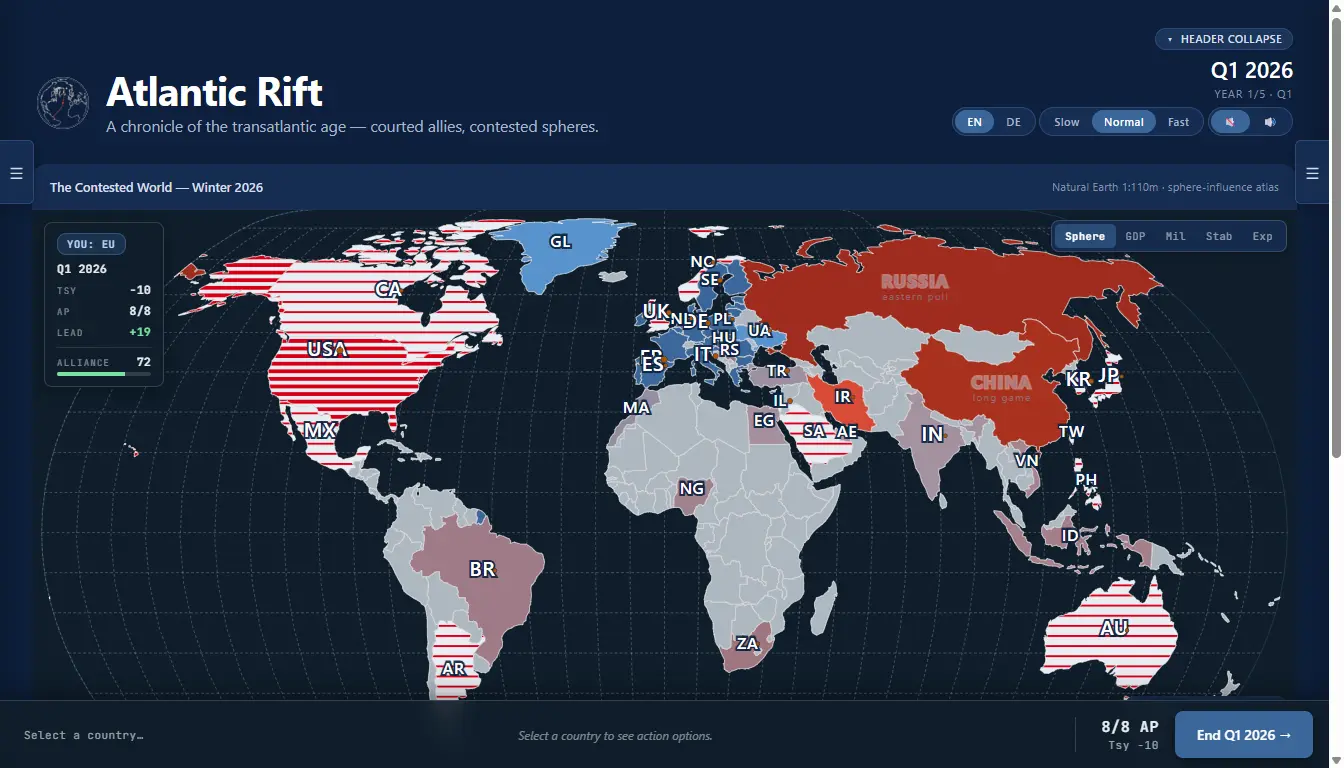
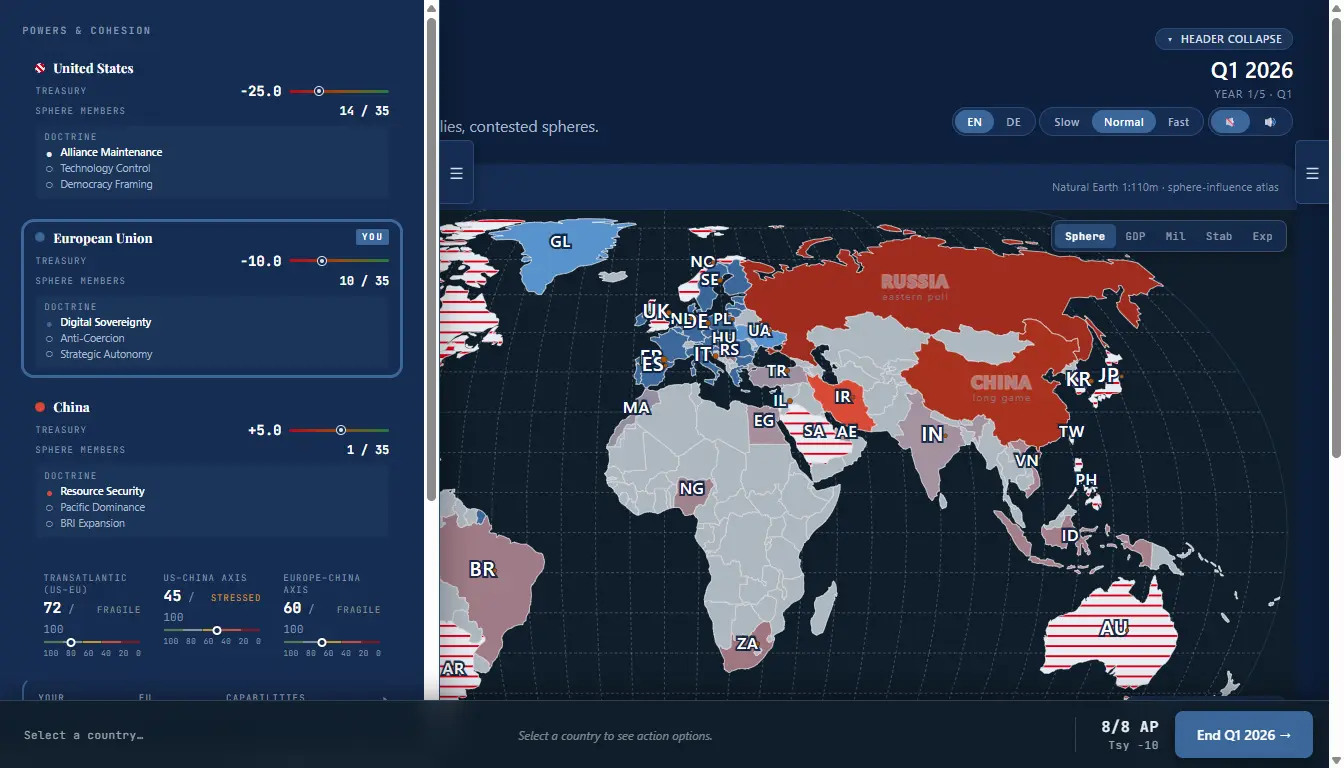
You pick a power and play sixteen quarters of policy. Every action shifts at least one bilateral relationship — there is no neutral move. Crises arrive through Mistral-generated dispatches, written at the country and policy-program level, never about specific named officials or weapons systems. The simulation runs in your browser; nothing is installed.
 Source: Screenshot: Atlantic Rift (in-game)
What is open in the build
Phase 0–2 are live (sphere model, bilateral cohesion, AI-generated dispatches, action language). Phase 3 (full agentic CN-sphere AI), Phase 4 (EU-coalition mechanic), Phase 5–7 (real-world crisis pool, deeper LLM integration, polish/audio) are the road ahead. The reviewer-pass on 2026-04-23 closed fifteen findings in a single day — a habit the build keeps.
 Source: Screenshot: Atlantic Rift (in-game)
“A strategy game where the goal is feeling like the EU at eye-level with the great powers — not winning, but staying relevant.”
Four ways to play.
 AI-generated illustration
US Sphere
Sets the standard, watches the borders.
Strong economy and military, projects power through alliances and the rules-based order. Slow to mobilize, hard to contain — every ally adds another node to the network.
- Carrier groups
- Coalition diplomats
- Intelligence networks
Atlantic Rift is conceived, designed and AI-pair-programmed by Daniel Papcke as a ConsultD showcase project. Cartography from Natural Earth (public domain). Libraries: D3.js and TopoJSON (BSD-3). Dispatches powered by Mistral AI (EU). Self-hosted analytics, anonymised, cookie-less.
Built in collaboration with Anthropic’s Claude — demonstrating what disciplined human-AI design partnership can produce. This cover story itself was co-authored with Claude (Opus 4.7).
Atlantic Rift is an independent fan project. Not affiliated with Chris Crawford, Mindscape, or any successor publisher; not affiliated with any government, political party, or organisation. All depicted persons, institutions, and events are invoked in the tradition of political commentary and satire. For educational and entertainment purposes only.
 AI-generated illustration
EU Sphere
Strategic autonomy by negotiation.
The magazine's preferred power. Strong on diplomacy, regulation, and economic levers. The Phase 4 EU-Coalition mechanic asks whether 27 voices can speak with one — and what happens when they do.
- Strategic Compass missions
- Single-market levers
- Coalition diplomats
Atlantic Rift is conceived, designed and AI-pair-programmed by Daniel Papcke as a ConsultD showcase project. Cartography from Natural Earth (public domain). Libraries: D3.js and TopoJSON (BSD-3). Dispatches powered by Mistral AI (EU). Self-hosted analytics, anonymised, cookie-less.
Built in collaboration with Anthropic’s Claude — demonstrating what disciplined human-AI design partnership can produce. This cover story itself was co-authored with Claude (Opus 4.7).
Atlantic Rift is an independent fan project. Not affiliated with Chris Crawford, Mindscape, or any successor publisher; not affiliated with any government, political party, or organisation. All depicted persons, institutions, and events are invoked in the tradition of political commentary and satire. For educational and entertainment purposes only.
 AI-generated illustration
CN Sphere
Patient, asymmetric, owns the infrastructure.
Plays the long game. Heavy infrastructure investment, asymmetric tech moves, patient with diplomatic friction. The Phase 3 release brings full agentic AI behavior to this sphere — expect surprises.
- Belt-and-Road corridors
- Infrastructure financing
- Long-term technology programs
Atlantic Rift is conceived, designed and AI-pair-programmed by Daniel Papcke as a ConsultD showcase project. Cartography from Natural Earth (public domain). Libraries: D3.js and TopoJSON (BSD-3). Dispatches powered by Mistral AI (EU). Self-hosted analytics, anonymised, cookie-less.
Built in collaboration with Anthropic’s Claude — demonstrating what disciplined human-AI design partnership can produce. This cover story itself was co-authored with Claude (Opus 4.7).
Atlantic Rift is an independent fan project. Not affiliated with Chris Crawford, Mindscape, or any successor publisher; not affiliated with any government, political party, or organisation. All depicted persons, institutions, and events are invoked in the tradition of political commentary and satire. For educational and entertainment purposes only.
 AI-generated illustration
Free Powers
Bargains across alliances, wins by being underestimated.
Not a sphere — a phenomenon. Mid-size powers that play all sides, hold a pivotal vote, and refuse to be tribute states. Hard to script, hard to coerce, central to every endgame.
- Hedging diplomacy
- Resource leverage
- Multilateral courtship
Atlantic Rift is conceived, designed and AI-pair-programmed by Daniel Papcke as a ConsultD showcase project. Cartography from Natural Earth (public domain). Libraries: D3.js and TopoJSON (BSD-3). Dispatches powered by Mistral AI (EU). Self-hosted analytics, anonymised, cookie-less.
Built in collaboration with Anthropic’s Claude — demonstrating what disciplined human-AI design partnership can produce. This cover story itself was co-authored with Claude (Opus 4.7).
Atlantic Rift is an independent fan project. Not affiliated with Chris Crawford, Mindscape, or any successor publisher; not affiliated with any government, political party, or organisation. All depicted persons, institutions, and events are invoked in the tradition of political commentary and satire. For educational and entertainment purposes only.
Spheres of Influence model
Three competing spheres (US, EU, CN) plus Free Powers. The old bloc-frame is gone — every action shifts who counts as inside, outside, or persuadable.
Bilateral Cohesion (no DEFCON)
DEFCON is replaced by three relational scalars — US–EU, US–CN, EU–CN. A covert action against one bilateral cost gets traded against another: there is no neutral move.
AI-generated dispatches
Crisis briefings are written turn-by-turn by an LLM, with an AI-Generated badge on every paragraph. The AI Act compliance edge is part of the design, not an afterthought.
EU coalition mechanic (Phase 4)
27 voices, one vote — eventually. The next phase asks whether the EU can be strategically autonomous when the room is divided. The first real test of the design vision.
Real-world crisis pool
Crises drawn from actual world events at the country/program level — never personal, never branded. Iran sanctions and trade-route disputes, not named officials or weapons systems.
Browser-first, offline-capable
No install, no client. Runs from a URL, caches for offline play, syncs when you come back. Designed to work on a school laptop and a workstation alike.