Building Atlantic Rift: A Balance of Power Homage, Co-Authored with AI
April 2026. I spent a week building a geopolitical strategy game with an AI as co-author. What came out surprised me more than it should have.
Atlantic Rift is a browser-based homage to Chris Crawford’s Balance of Power (Mindscape, 1985). You play the United States or the European Commission across sixteen quarters of a 2026 in which the transatlantic alliance is fracturing. Thirty-four countries, six regions, nine Instruments of Power per turn. Twenty to thirty minutes, start to finish. No login, no accounts, no tracking. You open a URL, you play, you close the tab.
Why Balance of Power, forty years later
Crawford’s insight in 1985 was that superpowers don’t conquer, they align. His game had no tanks, no territorial combat, no lines on a map that moved. It was a simulation of prestige, influence, and the constant low-grade risk of things escalating past the point where anyone could pull them back. If you pushed too hard, the game ended with a nuclear war screen and the text “You have ignored the fact that I don’t reward winners of nuclear wars.” Crawford meant it. The screen was deliberately anti-climactic.
Forty years later, the mechanics still describe the world better than anything that replaced them. NATO posture, sanctions, development aid, information ops — the game already knew. What’s changed is the texture: the risk of the rift is no longer the East-West wall, it’s the transatlantic seam itself. That’s the premise of Atlantic Rift. The rupture condition — “the moment the West stops being the West” — is a mechanic. If you trigger it, the game ends in a Yeats register, not a Crawford mushroom cloud.
Built with an AI as co-author, not as tool
I need to be precise about this because the phrasing matters. Atlantic Rift was co-authored with Anthropic’s Claude over about a week in April 2026. Not “I used AI to generate code” — that’s the weak framing and it’s also not what happened. What happened is closer to sitting down with a colleague who has read more design history than you have but has never shipped a game, and working out together what the thing should be. The game’s balance curves, the Rupture ending’s register, the decision to make the AI opponent deterministic-with-occasional-hail-marys instead of fully probabilistic — all of that came out of conversations, not prompts.
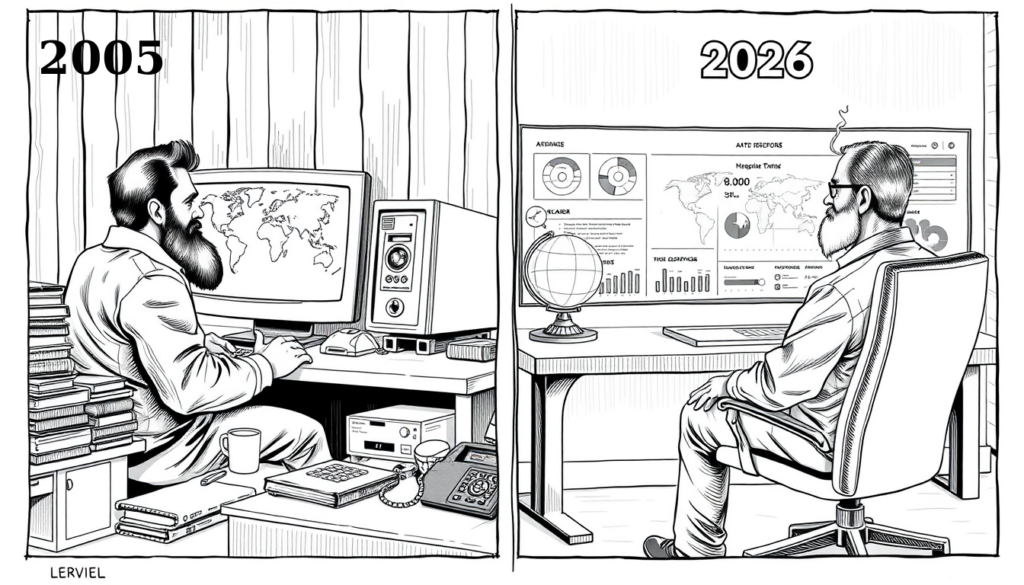
The honest report: neither of us could have built this alone. I have thirty years of strategic experience from innovation consulting and couldn’t have written an HTML single-page simulation from scratch in a week. Claude can write the code but has no lived sense of which design decisions produce a game that feels like something versus a game that feels like a spreadsheet. What worked was the friction between those two deficits. I’d propose a mechanic, Claude would point out an edge case I hadn’t seen, I’d remember a 1980s strategy game that had solved it differently, Claude would sketch three variants. That kind of thing, several hundred times.
The technical posture
About 100 KB of HTML, three self-hosted JavaScript libraries, one 120 KB Natural Earth atlas, one optional PHP endpoint that proxies a Mistral call for flavor headlines. That’s the whole game. No database, no build step, no framework, no CDN calls. The Apache server keeps fourteen days of logs per the privacy notice and nothing else. If atlanticrift.cc disappeared tomorrow, you could still run the game by saving the HTML file.
This is a deliberate aesthetic, not just a constraint. The game is supposed to feel like something you could have found on an Amiga disk in 1988. The type is Playfair Display and JetBrains Mono, the paper-on-ink palette is borrowed from Cold War-era intelligence briefings, the between-turn dispatch reads like a wire-service digest. None of that is accidental — it’s the register Crawford worked in, and the register that makes the simulation feel weightier than its file size.
Where it’s going — v2, “Spheres of Influence”
The v2 track, which went live on this domain in April 2026, shifts the win condition. v1 asked which bloc ends stronger in a binary sense. v2 asks a harder question: can the European Commission reach eye-level parity with the United States without rupturing the alliance in the process? It’s a subtle pivot, but it changes how you play. You start thinking less about dominance and more about what spheres of credible influence look like when there are three or four of them in play instead of two.
Whether that succeeds as a design is an open question. I’ll write about it again when I have more hours of playtesting behind me. For now: atlanticrift.cc. Twenty to thirty minutes. No install. See what you think.
Atlantic Rift is a non-commercial strategy simulation by Daniel Papcke, co-authored with Anthropic’s Claude. It’s released under a DNA-enhanced-by-AI credit line as a ConsultD production. The game itself is free to play at atlanticrift.cc.
This essay was co-authored in the same spirit: the thinking and judgments are Daniels, the prose polished with Anthropics Claude. Consistent with the AR credit line and EU AI Act Art. 50 transparency.