PCPlayerHub
A magazine for people who play with maps
§ Cover story · ConsultD · indie PCPlayerHub

Atlantic Rift v2 — Spheres of Influence

“A strategy game where the goal is feeling like the EU at eye-level with the great powers — not winning, but staying relevant.”

§ Latest articles · the magazine PCPlayerHub
  • Hearts of Iron IV Tutorial: Part 3 Air Power

    Hearts of Iron IV Tutorial: Part 3 Air Power

    In part 2 of the tutorial (Land Combat), we examined land combat.

    Land combat is probably the most important aspect of the military in Hearts of Iron 4. However, one should not underestimate the importance of air power. 

    Air power serves as a force multiplier for your land forces and as such, can be the difference between victory or defeat. 

    In this section of the tutorial, we will examine all of the basics of air power so that you can take advantage of all of your country’s potential.

    Planning: What do I want my Air Force to Do?

    There are several important aspects to consider when planning and building an air force in HOI4. Plane types, their stats, what missions they can perform, as well as basing and logistics all need to be taken into account if one is to utilize air power effectively. 

    Stats

    Here we will go over some of the more important stats for planes.

    Speed – Speed is important for almost all planes. Having a speed advantage over enemy planes reduces their ability to damage yours. It also increases your own damage against enemy planes. 

    Agility – Agility is how difficult your plane is to hit. Higher agility combined with high air defense will make your planes very resilient. Agility also affects how easy it is for your plane to damage an enemy plane, thus having high agility for fighters is key.

    Range – Range is simply the operating radius of the plane. Planes assigned to air regions that are larger than their range will suffer mission efficiency penalties, which can be substantial.

    Air Attack – Air attack is a measure of how much damage your plane can do to enemy planes. 

    Air Defense – Air defense is how much damage your plane can take before being shot down.

    Ground Attack – Ground attack measures how much damage your plane can do to enemy divisions. This is both organization and strength damage. 

    Strategic Attack – Strategic attack is how much damage your plans can do to enemy buildings such as civilian and military factories, forts, refineries etc. It has no direct effect on enemy ground troops. 

    Naval Attack – Naval attack is how much damage your plane can do to an enemy ship. Especially important for any carrier-based planes. 

    Naval Targeting – Naval targeting is a measure of how likely your plane is to land a hit on an enemy ship. 

    Plane Types

    There are 8 basic plane types in HOI4:

    • Fighters
    • heavy fighters
    • close air support
    • tactical bombers
    • strategic bombers
    • naval bombers
    • scout planes
    • and transport aircraft.

    (There are technically more if you count the carrier variants you can build for some of the types). Jet aircraft and rocket interceptors aren’t really useful in the game so I won’t cover them in this guide. 

    Each plane type has certain strengths and weaknesses that make it more suited to certain missions and roles. 

    Fighters – Fighters are the most prevalent plane in the game. They are used to wrest control of the sky by shooting down enemy planes. They can also defend your own airspace against enemy bombing raids. 

    They have the highest speed and agility of any plane, which makes them ideal for this role. They can only perform air combat, however, are limited to air superiority and intercept missions. 

    Heavy Fighters – Heavy fighters have a similar function to regular fighters. They are designed to shoot down enemy planes in order to establish air superiority over your enemy. 

    There are a few differences though. Heavy fighters are slower and less agile than fighters but they have a much higher air defense. This makes them ideal for attacking enemy bombers when running the intercept mission. 

    Additionally, they have a much longer range than fighters which means they can function as fighter escorts for your own long-range bombers. 

    Close Air Support – These are rather short-ranged dive-bombers whose primary function is to support your army in combat by bombing enemy divisions. They have the highest ground attack score of any plane. They can also function as naval bombers in a pinch. 

    Tactical Bombers – A personal favorite of mine, tactical bombers are the jack-of-all-trades plane. They have a decent ground attack, naval attacks, naval targeting, and even strategic attack. This makes them capable of filling any bombing role you need them to, albeit worse than the specialized bombers. 

    Tactical Bombers have more than twice the range of close air support and naval bombers, which is another nice bonus. 

    Strategic Bombers – These are the big boys. Massive four-engine bombers that are expensive to build, but that can absolutely devastate enemy industrial output. Having decent air attack and defense means that, while they won’t be winning you air superiority, they are no pushover in air combat. 

    Because of their expense, they are not suitable for every country to build. 

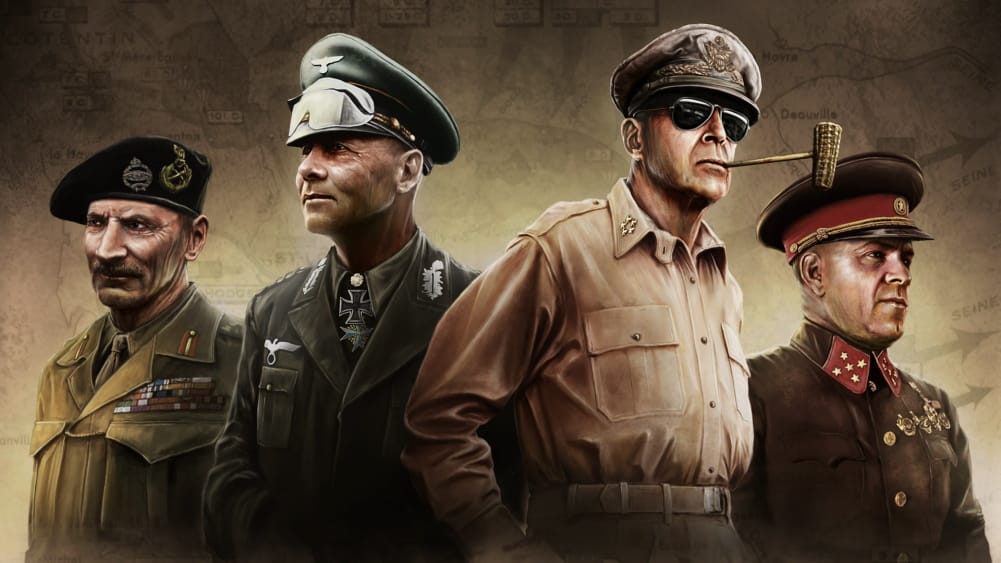
    If we lose the war in the air, we lose the war and we lose it quickly

    Field Marshall Bernard Montgomery (1887-1976)

    Naval Bombers – Curiously, naval bombers in HOI4 have a quite limited range, unlike their real-life counterparts. They make up for that though with the ability to shred enemy fleets. Having enough naval bombers can make an enemy fleet think twice about sortieing out. Unfortunately, they are unable to perform any other missions other than naval and port strikes so they cannot double as ground-attack aircraft. 

    Scout planes – Scout planes are used in HOI4 to gather intel. The intel gathered builds up slowly over time and acts as a bonus to your national intel on an enemy nation. 

    Having an intel advantage over your opponent gives your ground divisions a boost in combat performance. 

    Transport Planes – Finally, we come to transport planes. They are rather expensive to build but they allow for some key missions: Para drop and air supply.

    Dropping paratroopers behind enemy lines can be effective if done right and under the correct circumstances. 

    However, the air supply mission is where they really shine. Transport planes allow you to have some room for error when it comes to supplying your troops. I build them any time I’m playing a major. 
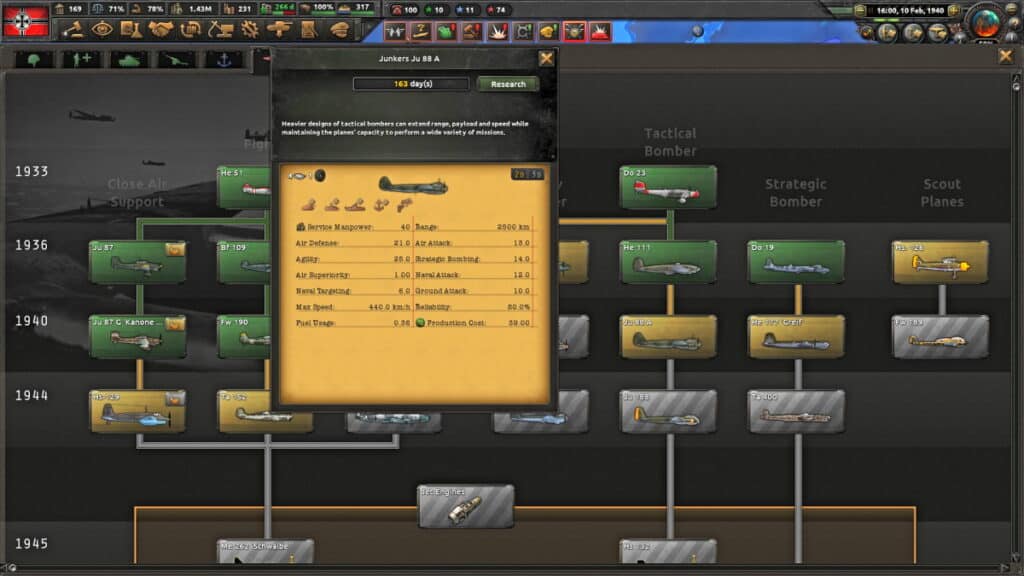
    Hearts of Iron 4: Tactical bombers - the do it all plane
    Hearts of Iron 4: Tactical bombers – the do-it-all plane

    Mission Breakdown

    Now let’s look at the different missions your planes can undertake in Hearts of Iron 4. Note that not all planes can perform all missions.

    Pilot Exercises – While not a combat mission, pilot exercise is a critical mission nevertheless. When running pilot exercises, your airwing will gain experience (up to ‘regular’ level). This is useful in peacetime to get your air force ready from the moment that war kicks off.

    It will also generate a very small amount of air experience for your country. Keep in mind that this all comes at the cost of fuel spent and an increase in air accident rate. 

    Air Superiority – Airwings performing this mission will attempt to engage and destroy enemy air wings operating in the region. When you want to gain air superiority over an air region, this is the mission to run. Only fighters and heavy fighters can run this mission. 

    Air Intercept – A defensive form of air superiority, airwings running intercept will attempt to disrupt and destroy enemy bombers running bombing missions. 

    Keep in mind that your air wings will not engage enemy fighters. This mission is useful to defend your airspace from bombing attacks. 

    It can also be used if you are significantly outnumbered or outclassed by the enemy fighters and want to avoid them. 

    Close Air Support – Airwings running close air support will attack and damage enemy ground divisions. They will only attack if there is active land combat happening in the air region so you can’t set your bombers to ‘soften up’ the enemy before an offensive. 

    There is also a limit on how many of your bombers can attack the enemy which is based on the combat width size of the land battle.

    In addition to the raw strength and organization damage they do, close air support attacks will provide a combat bonus to your ground divisions. 

    Remember that to be most effective, your bombers have to get through to attack without being disrupted. This means having dominance over enemy airpower in the region. 

    Strategic Bombing – Strategic bombing has no direct effect on land combat. Rather, it is the bombing of enemy buildings, infrastructure, and industry. 

    Within the strategic bombing mission, it is possible to prioritize targets to make your planes focus on radar, forts, airbases etc. 

    Targeting an enemy’s industry can cripple their war effort. Although, you should keep in mind that strategic bombers are quite expensive to build and that a fairly large amount of them will be required to inflict significant damage on the enemy. 

    Naval Strike – Naval strike is a mission that targets enemy ships in an air region over the sea. In order for your planes to actually attack the enemy, their ships must first be detected/found. If there is already a naval battle happening, your planes will automatically join the fight.

    Thus, coordination between your air force and navy is critical for this type of mission. Naval strike can also target enemy convoys, although only those carrying troops. 

    Port Strike – Port strike also targets enemy ships while they are at base in a port. Therefore, a port strike must target a land region with one or more ports in it. Unlike other missions, port strikes require at least 30% air superiority in the chosen region before they can be launched. 

    Logistics Strike – Newly added in the No Step Back DLC, logistics strike attempts to choke enemy supply by targeting trains and trucks. If the enemy has a deficit of these in their national stockpile, their logistical capability will be limited. Keep in mind that if you want to damage their railways, you will need to run a strategic bombing mission.  

    Air Supply – Transport aircraft are the only planes that can run the air supply mission. The amount of supply that each plane can bring has fluctuated as Paradox tries to get the balancing right. 

    In any case, lacking range or not having air superiority will reduce mission effectiveness, which in turn will reduce the number of supplies that you can transport. 

    Air Recon – Scout planes are the only aircraft that can run the air recon mission. Each scout plane will slowly add to your country’s total intel on another country until it reaches the cap. The more scout planes you add, the faster the intel will grow. 

    Hearts of Iron 4 bombers running the close air support mission
    In addition to damaging enemy divisions directly, my bombers running the close air support mission are providing my divisions a +35% boost to their attack. Nice!”

    Organization & Logistics

    Now that we know what types of planes to build and what missions we want them to perform, let’s look at how to actually deploy and use them. Airwing size, air bases, radar, and spirits are all things to consider when using air power in the field. 

    Airwing Size – You can deploy air wings with just 1 plane all the way up to 1000 planes. So which size is the right size? 

    Most players like to use wing sizes of 100. This gives you flexibility allowing you to target multiple air zones. It also means you can stack airwings on air bases efficiently without suffering over-stack penalties. 

    All airwings must be of only one type of plane, meaning you can’t mix bombers and fighters in the same wing. 

    Air Bases – Air bases are needed to station your airwings. They can be built from the construction tab. Placement is important, as airbases will need to be in range of where you intend to launch your missions. 

    Each level of airbase can operate 200 planes. The maximum is level 10 for 2,000 aircraft. Stationing more aircraft than the capacity allows will lead to over-stacking penalties, which can be crippling to mission efficiency. 

    Carriers – Airwings can also be based on aircraft carriers. The amount of them is limited by the deck size of the carrier. Larger deck sizes means more planes. 

    Remember that only specific carrier variants of planes can be based on them. Regular planes cannot.

    Radar – Having radar stations built in your territory will give a substantial bonus to detection. Detection, as we will see in the next section is crucial in air combat. Be sure to keep up with research and construction on radar if you intend to control the skies over your own territory. 

    Spirits – The No Step Back DLC added the officers tab. In this tab, you can select certain spirits for your armed forces using relevant experience. These spirits add certain bonuses to the branch ranging from increased research speed, faster training, mission efficiency buffs, etc. Be sure to look through them and decide which best fit your overall strategy for your air force. 

    Hearts of Iron 4 radar station built gives me partial but not full radar coverage
    Having a level 2 radar station built gives me partial but not full radar coverage in Western Germany. This in turn helps my fighters detect and intercept Allied bombers

    Air Combat: Owning the Sky

    Now that you have planned and built your air force, it’s time to put it into action. But how exactly does air combat work? The answer is a series of complicated mathematical formulas, the scope of which is a bit beyond this tutorial. This is the respective HOI4 wiki

    I will, however, give a general overview of air combat and how it works in Hearts of Iron 4.

    Detection

    As mentioned earlier, detection plays a critical part in air combat. Simply put, if you don’t know where enemy planes are, you can’t engage them. In-game terms the amount of air detection you have determines the number of your own planes that can engage the enemy planes. 

    For example, if the enemy launches a bombing raid over your territory and you have fighters set to engage, if you have low detection then none or only a handful of your fighters will actually enter combat. 

    Detection is improved by occupying ground in the air region (think having more ground spotters), having planes in the air region running missions, building radar installations that cover the air region, and by having certain doctrines and spirits. It is impaired by nighttime (-20%) and bad weather (-90%). 

    Hearts of Iron 4 bad weather low disruption rate
    Due to the bad weather, my detection is quite low at 13%. This makes it very difficult for my fighters to effectively engage the Allied bombers. Notice the low disruption rate

    Damage

    When your planes attack enemy planes they will use their air attack stat to deal damage to the enemy plane. If the damage done to a plane is higher than its air defense stat, it will be shot down. Planes use agility and speed to avoid being hit and to gain an offensive bonus against other planes. Once again, the wiki provides the actual formula if you are interested. 

    Disruption

    Shooting down enemy bombers is great but what happens much more often is disruption. Disruption occurs when bombers are engaged by fighters and forced to abandon their mission and return to base. 

    If air detection and fighter presence are high enough, it is possible to completely disrupt bombers and render them useless. 

    Disruption can be countered by ‘escorting’ bombers with fighter wings set to run the air superiority mission in the same air zone. This works by forcing the enemy fighters to also engage with your own fighters, thus freeing up your bombers from harassment. 

    Air Superiority

    Air superiority in HOI4 is simply the percentage of control over a particular air region that you have. It is a tug-of-war percentage of 100. Your air superiority score is increased by having planes running missions in the region. Even planes not running the ‘air superiority mission will contribute to this score.

    Each plane gives 1 point of air superiority, however, there are exceptions. Heavy fighters give 1.25 and strategic bombers only give .1. Scout planes and transport planes provide none. Building static AA will reduce the enemy’s air superiority score.

    An air superiority level of less than 40% is known as ‘red air’. 60% and up is known as ‘green air’ and 41-59% is known as ‘yellow air.’ 

    Air superiority is vital in HOI4 because, for every 50 points of air superiority you have over your opponent, their ground divisions will suffer a 1% penalty to their defense and breakthrough stats. 

    Having air superiority will also affect enemy divisions’ movement speed making them slower (to simulate only being able to move at night etc). 

    Image 5 Hearts of Iron 4 the Allies really have me outgunned here
    With a 32% air superiority score, the Allies really have me outgunned here. If I don’t do something about the situation in the air, my ground divisions will find it increasingly difficult to fight effectively

    So there it is; the basics of air combat in Hearts of Iron 4. You should now have everything you need to conceptualize, build, and use air power.

    Use the knowledge to dominate the skies and remember the wise words of Field Marshall Montgomery “If we lose the war in the air, we lose the war and we lose it quickly.”

  • Hearts of Iron IV Tutorial: Part 2 Land Combat

    Hearts of Iron IV Tutorial: Part 2 Land Combat

    While part 1 of this tutorial guide looked at the economy as the foundation of your country’s power, parts 2, 3, and 4 will focus on the military: the primary application of your country’s power. {If you haven’t checked out part 1 of the tutorial, you can access it by following the link here.} Having the strongest economy in the world doesn’t mean much if you can’t leverage it with a competently designed, well-trained military. 

    In this guide, we will look specifically at land combat. Land combat is by far the most prevalent form of combat in the game. As such, it will be the largest of the military guides. We will look at basic combat mechanics, combat width, logistics, an overview of unit stats, as well as terrain modifiers. 

    Combat Mechanics 

    Combat in HOI4 is a combination of unit statistics, modifiers, and dice rolls. Understanding how these all interact with one another is vital to finding success on the battlefield. 

    Cardinal Stats: Organization & Strength

    Organization is the single most important stat for your divisions. It represents the willingness and ability of your units to fight. If your division’s organization is at zero, it can’t fight. 

    Organization is lost from movement, combat, and lack of supply. If your unit is in supply, it will recover over time. Your unit’s organization cap can be increased with various doctrines that can be found in the officer tab and unlocked with army experience. 

    Strength represents, well, the strength of the division. It is always represented as a percentage of 100. Strength includes both a division’s manpower and, more importantly, its equipment. If your division is not at full strength, its stats will be lowered accordingly by whatever equipment it is missing. If divisions are in supply, they will reinforce automatically as long as there is equipment and manpower available. 

    Offensive Stats: Soft Attack and Hard Attack

    Soft attack measures how many attacks your unit can make against an enemy unarmored (soft) unit. In this case, the higher the number the better. Certain battalions like artillery provide a substantial amount of soft attack. 

    Hard attack is the same mechanic but for attacks against armored (hard) units. These values tend to be much lower than soft attack for most battalions. Some battalions such as anti-tank, however, provide a large amount of hard attack.

    Defensive Stats: Hardness, Breakthrough, and Defense 

    Hardness is the ratio of enemy soft and hard attacks that your division will be affected by. It is always expressed as a percentage of 100. Essentially, hardness is supposed to represent the percentage of the unit that is armored.

    If a unit has a hardness of 10%, it means that it suffers 90% of enemy soft attacks and 10% of enemy hard attacks. Conversely, a unit that had 90% hardness would only suffer 10% of enemy soft attacks while taking 90% of their hard attacks. 

    Because of how much more soft attack units tend to have compared to hard attack, it is always worthwhile to make your units as hard as possible. 

    Defense is a measure of how good your unit is when holding ground. If your unit’s defense stat is higher than the enemy’s attack stat (soft and hard together in the correct proportion), then your unit only has a 10% chance of taking a ‘hit’. If the enemy has higher attack than your defense, that chance goes up to 40%. 

    Breakthrough functions the same as defense except that it applies when your unit is attacking. Thus, having high breakthrough is crucial for your attacking units. 

    Each ‘hit’ in combat deals 1d2 damage to your unit’s strength and 1d4 damage to your unit’s organization. As stated earlier, when a division’s organization hits zero it must disengage from combat and retreat. 

    Because of its high breakthrough, the German motorized division is able to ‘absorb’ all of the attacks from the Polish division only getting hit 10% of the time
    Because of its high breakthrough, the German motorized division is able to ‘absorb’ all of the attacks from the Polish division only getting hit 10% of the time

    Combat Width 

    Combat width is very important to understand in HOI4. Not building divisions intelligently in regards to width is probably the number one mistake new players make when first playing the game. Having trouble pushing through the Low Countries on your way to Paris as Germany? Combat width probably has something to do with it. 

    Divisions in HOI4 take up a certain amount of space at the front. This is referred to as combat width. Ideally, you want to completely fill up all available width but not exceed it. If you exceed the available combat width, all of your units involved will suffer stacking penalties.

    Since the No Step Back DLC and update, each different terrain type now has a different combat width. There is no longer a ‘one-size fits all’ width template for divisions. 

    All tiles have a base combat width. Any additional attacks coming from different tiles will increase the width of the battle by half or a third of the original base width. For example, plains and deserts both have a base combat width of 90 with an additional 45 added for attacks incoming from a different tile. So, if a plains tile was being attacked from three different tiles, the combat width would be 180. But, if a mountain tile (width 75) was being attacked from three different tiles, the combat width would only be 125. 

    Here is a list of all-terrain types and their combat widths.

    Plains – 90 (45), Desert – 90 (45), Forest – 84 (42), Jungle – 84 (42), Hills – 80 (40), Mountain – 75 (25), Marsh – 78 (26), Urban – 96 (32)

    With these widths in mind, a common division template players build is a ‘9-1.’ This is 9 battalions of infantry and 1 battalion of artillery. It has a width of 21. 21 is a nice width because it allows four divisions to attack most terrain types without any stacking penalties. 

    We will dive further into terrain and how it affects combat later in this guide.

    Combat width is 90 in plains provinces. If I attack with a division to the North, it will expand the width to 135

    Logistics

    “Amateurs study tactics, professionals study logistics.” A common military saying that also strikes true for HOI4. Without supply, even the most experienced, well-equipped division will be useless. Divisions out of supply will suffer a progressively harsher penalty depending on how much supply they are short. If a unit is completely out of supply, it will not recover organization and will slowly lose it.
    Since the No Step Back DLC, logistics has gotten a rework. While being difficult to understand at first, once you get the hang of it, it is actually very straightforward.  

    Supply Draw

    Each of your divisions has a supply use stat. This information can be found on their division template. Supply use is how much supply is needed to keep the division in supply and performing at full capacity. Keeping supply use as low as possible is recommended and the logistics support company does just that. More on that later. Note that unlike previous versions of the game, supplies no longer need to be produced. 

    Railways and Throughput

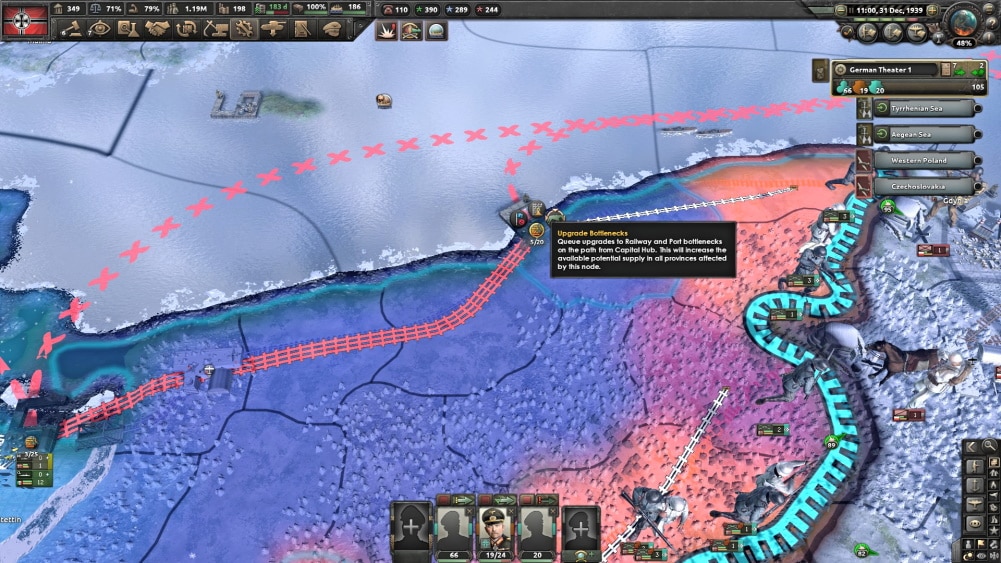
    The main mover of supply is now constructible railways and trains. Level 1 railways provide 15 supply to the hub they are connected to. Each additional level of railway provides another 5 supply to the hub for a maximum of 35 with a level 5 railway. In order to get the desired throughput, all railways from the capital to the supply hub must have the appropriate level of railway. Throughput is always based off the level of the lowest relevant railway for the connection so be on the look out for bottlenecks!

    Here you can see a bottleneck in supply due to the railway level being too low. By clicking the upgrade bottlenecks button, all of the relevant railways all the way to the capital will be automatically queued up for construction

    Supply Hubs

    Supply hubs have a maximum range from which they can supply units. The ability for a hub to supply a unit gets progressively worse the further away a unit is from the hub. Eventually, a unit will be too far away and will be unable to be supplied from the hub. This is why when you are conducting offensives, it is vital to locate enemy supply hubs and capture them as without them, your offensive will quickly grind to a halt.  

    You can increase the range of your supply hubs a few ways. The first is simply to increase the amount of supply that is getting to the hub. Having level 5 railway connections all the way to the capital really helps. 

    You can also increase the motorization level of the hub. You can do this by clicking on the hub and then clicking on the horse icon and changing it the truck icon. There are two levels of motorization. Level 1 takes 40 trucks per hub and level 2 takes 80. Remember that these trucks do not require fuel but will suffer from attrition and enemy air attacks. 

    Finally, you can increase the infrastructure level. Each level of infrastructure will allow the hub to transfer more supply to the next province over. Although it is a small amount, it is per each province so it adds up quickly. 

    The dark red hashed lines show which provinces are currently in range of the supply hub. By clicking on the motorization button, the range will be increased to the brighter pink hashed lines

    State Supply

    Supply also comes directly from the states you control. The amount is based off the population level, the amount of Victory Points (if any) present, and the level of infrastructure. Keep in mind that this amount of supply is generally very low and to support any large amount of units will require a logistics network as we have previously discussed. 

    Weather

    “The two rules of warfare:

    1. never start a land war in Asia.
    2. never march on Moscow in the winter.

    Another military maxim that also strikes true for HOI4. Since No Step Back, weather and weather effects now greatly affect your logistics and thus your ability to conduct effective military operations. 

    Both acute weather effects such as blizzards, sandstorms, and storms as well as seasonal climatic effects like cold or hot temperatures, deep snow, and mud can absolutely devastate a logistics network. 

    Fighting in such conditions is ill-advised unless it is absolutely necessary. 

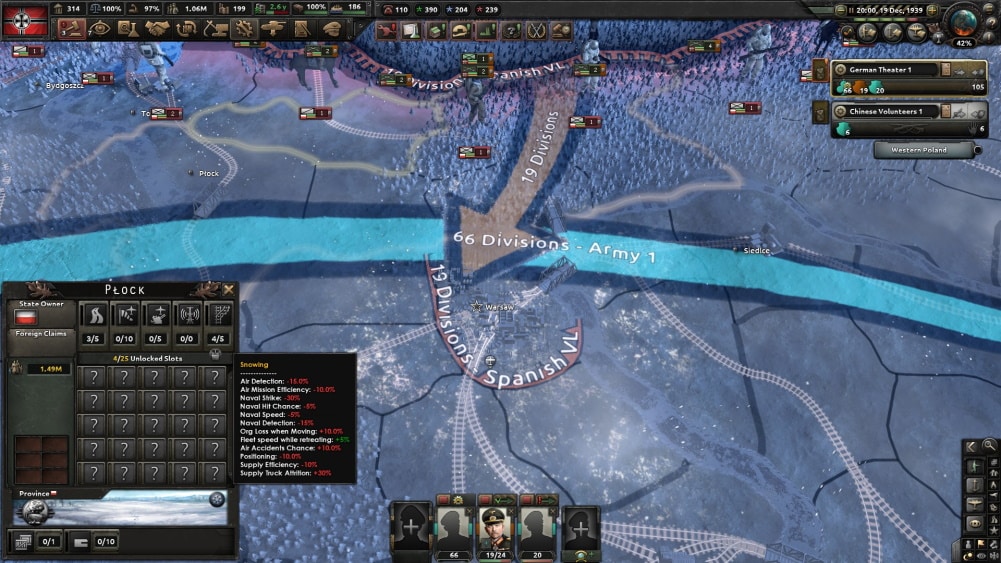
    In the lower left part of the screen you can see the negative effect the snow has on logistics. Keep in mind this is only snow in December. It gets worse!

    Air Supply

    Finally, we come to air supply. If you are playing as a major nation, you may well have a decent-sized fleet of transport planes. It is possible to set them on the mission ‘air supply’ and have them drop supplies to your units. Keep in mind that if the enemy has air superiority, this will not go well. Additionally, the amount of supply that can be air dropped is relatively small so don’t expect to supply entire armies with it. It is more of a band-aid type of solution.

    Unit Statistics

    While we already looked at some key unit statistics like hard and soft attack, defense, etc, here we will go over some other stats. I won’t cover all unit stats but rather highlight some of the more important ones and explain how they function in the game. 

    Armor and Piercing

    If a unit has a higher armor rating than an enemy has piercing then it gets a massive boost in combat. It only suffers 50% of all enemy attacks hard or soft. Additionally, it deals an extra 50% organization damage to the enemy unit. If the enemy has more piercing than you have armor, then your units are ‘pierced’ and combat happens as it normally would without any bonuses or penalties. Piercing in HOI4 is all or nothing. It doesn’t scale. 

    To add armor to your divisions add more hard units like tanks and half-tracks and remove soft units like infantry. You can also upgrade the armor level of your tanks. To improve your division’s piercing stat consider adding anti-tank battalions, anti-air, or tanks and tank destroyers. 

    Keep in mind that armor and piercing are averaged for the entire division. If you have just 1 battalion of heavy armor or 1 battalion of heavy tank destroyers mixed with many battalions of infantry, the armor and piercing stats for the entire division will be reduced. 

    HP

    HP in a division affects how much manpower and equipment you lose when your unit inevitably takes losses. Low-HP divisions will take more manpower and equipment losses for each % of strength lost. Infantry has the highest HP stat of all the battalions and is usually a core component of any division. This is why pure tank divisions fare poorly in HOI4. 

    Air Attack

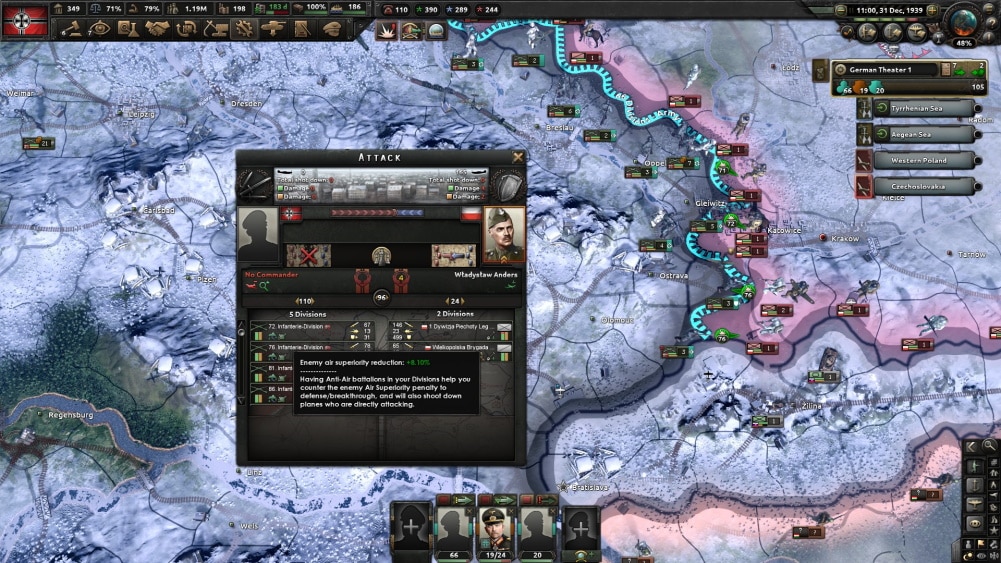
    Divisions with a high air attack stat have the chance to deal considerable damage to enemy planes that are bombing them. Unless you anticipate having air supremacy, having some air attack in your divisions is usually a good idea. In addition, shooting down planes, it reduces the bonus from air superiority that an enemy might get. Finally, it also has the effect of increasing the division’s piercing stat by a fair amount. Your units can only engage enemy planes that are actively targeting them with ground attack. It has no effect on strategic and logistical bombing done by the enemy. 

    Here we can see how having AA in my divisions is reducing my penalty for the Poles having air superiority

    Manpower

    Manpower is how many men are required to keep the division at full strength. If you are a nation pressed for manpower you can either increase the level of conscription law (although this has heavier penalties for your economy the further you go), or design divisions that are less manpower intensive. Infantry is a very manpower-intensive battalion whereas artillery or armor provides much more firepower for less manpower cost. 

    Entrenchment

    Entrenchment is how much of a bonus your units will get from digging in. Any unit that is stationary and not in combat will start digging in. Dug-in units receive combat bonuses for their offensive and defensive stats. This only applies when they are attacked however as it is lost as soon as they move. 

    The higher a unit’s entrenchment stat is, the higher its dug-in bonus will be. Most units share their country’s base entrenchment stat but it can be increased by adding an engineer support battalion as well as certain command traits and doctrines. 

    Trickle Back and Exp Loss

    If you add the hospital support company, you will see trickle back and exp loss added to your unit’s stats. Trickle back works by adding a small amount of manpower back to your national pool from any combat losses you might take. Exp loss means that each casualty your division takes will bring down the overall unit’s experience level by a lesser amount. 

    While these bonuses sound amazing and great to have, unfortunately, they are not. The way HOI4 is set up, the hospital support company is very expensive in terms of industry and opportunity costs. Additionally, most nations never have manpower shortages so it’s only worth it in a few niche cases. 

    Terrain Modifiers

    We already looked at the terrain as far as it pertains to combat width. Now let’s examine how terrain impacts combat as a whole. 

    Plains

    Plains are the basic terrain type in HOI4. They have no modifiers whatsoever. This makes them the easiest to attack but the hardest to defend. 

    Deserts 

    Found in North Africa and the Middle East, deserts are common enough in HOI4. They don’t give any combat penalties but they are taxing logistically. Fewer supply moves from hubs and supply trucks take more attrition. Additionally, all equipment is subject to a +15% attrition penalty. Units also suffer a -5% to movement cost. Finally, your generals have an increased chance to fall ill. In deserts, less is more. Try to make due with fewer units. Large armies have no place here. 

    Forests

    Forests give a -15% attack penalty as well as -50% to movement cost. There is also a small penalty to supply flow from hubs and truck attrition but it isn’t as bad as in other terrain types. Having air superiority will only provide 90% of its bonuses here. While attacking into a forest isn’t ideal, it also isn’t horrible. 

    Jungles

    Fortunately, jungles are not found in the main battle arena that is Europe and its periphery. However, the Asian, African, and South American theaters have plenty of them. Jungles give some nasty penalties. -30% attack, -50% movement cost, +20% attrition rate, as well as a very large truck attrition rate means that they are not fun to attack or defend. As with deserts, your generals have an increased chance of falling ill here. Air superiority counts for significantly less here so it is a terrain that can act as an equalizer for two mismatched opponents. 

    Hills

    While definitely an idyllic landscape, hills aren’t great to attack into. They give a -25% to attack and -50% to movement cost. Air superiority is only 95% effective here and there is a small penalty to supply flow from hubs and truck attrition. If you anticipate fighting a lot in hills, it would be worthwhile to recruit mountaineers who will have bonuses in such terrain. 

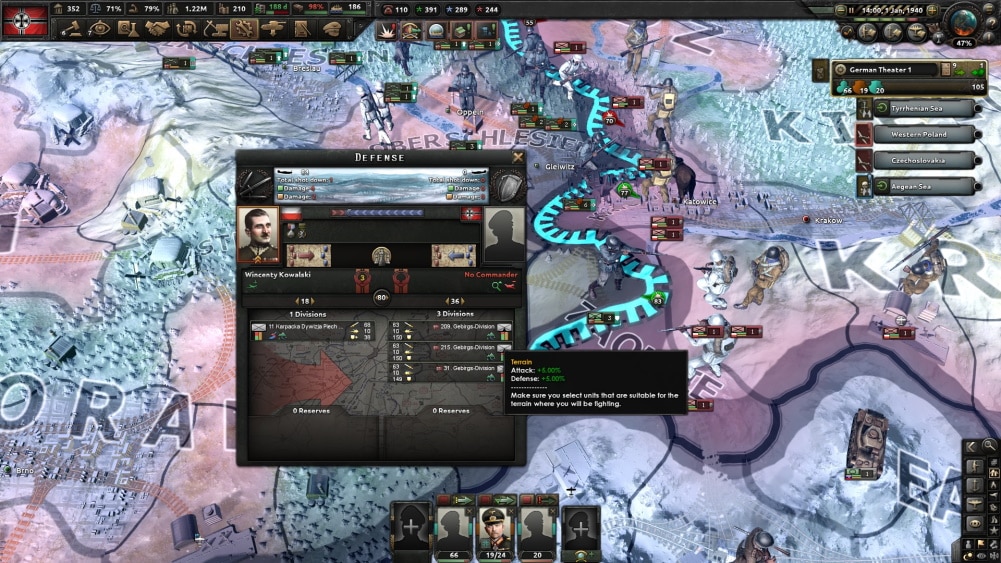
    Due to their special training, Mountaineers actually receive a terrain bonus in hills

    Mountains

    Mountains are big hills. They give a whopping -50% to attack and -100% to movement cost. Supply flow from hubs is reduced and truck attrition are significant here as well as a general +30% attrition rate on all equipment. Mountaineers have milder versions of the attack and movement penalties so if combat in mountains can’t be avoided, it is best to use them. 

    These harsh penalties along with a narrow base width of 75 means that mountains are one of the most difficult tiles to attack.

    Marshes

    Just like the Dead Marshes in the Lord of the Rings lore, marshes in HOI4 should be avoided at all costs. This is the absolute worst terrain to fight in. +100% movement cost, +35% attrition rate, -40% attack, increased chance of illness, and massive supply hub flow and truck attrition penalties make this terrain type a nightmare to deal with. Forcing your opponent’s divisions into marshes while avoiding them yourself is a sound strategy. 

    Urban

    Urban areas are very common in Europe with most countries at least having a few tiles. Urban areas give a +20% movement cost, and -30% attack penalty. Air superiority is only 50% effective here. Urban is the only terrain type that actually provides a supply hub flow bonus. As previously stated, urban areas have the highest combat frontage at 96 which means that being outnumbered here will hurt the most. However, if they can match enemy numbers and dig in, defenders can be very difficult to evict from urban tiles. 

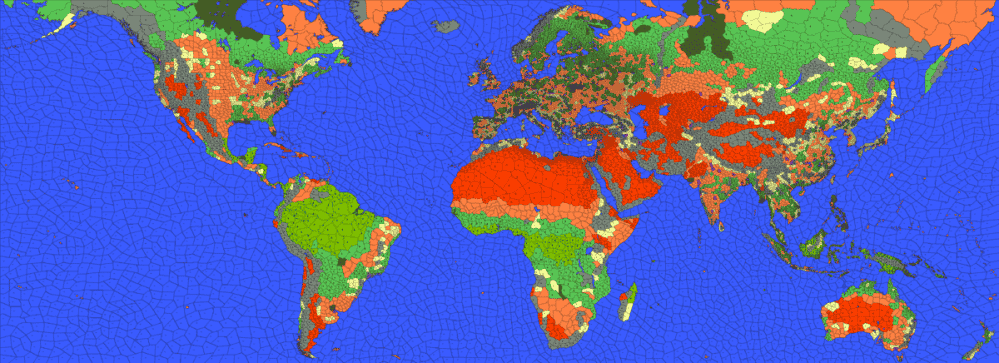
    Pulled from the Hoi4 wiki, here is a terrain map showing where all the different terrain types are in the game

    Where Water Meets Land

    Although not actually being tiles, rivers and straits need to be discussed here as well. In HOI4, all rivers are classified as either small or large. Small rivers give -30% to attack and -25% to movement cost. Large rivers give -60% to attack and -50% to movement cost.

    Amphibious assaults across straits or across open water with transport ships gives a large -70% to attack. Some of these penalties can be lessened through general traits and special abilities. Like mountaineers in their niche terrains, marines perform well here. 

    Keep in mind that all of these terrain bonuses and penalties are just the base. Every battalion has its own terrain penalties or bonuses that stack with these. For example, a heavy tank battalion will perform much worse than an infantry battalion when attacking a forest, etc. 

    By now, you have the basics of land combat in Hearts of Iron 4. It is a lot of information to digest. But over time, it will become second nature to you. In the next section of the guide, we will look at combat at sea and in the air.

    See you there!

  • Hearts of Iron IV Tutorial: Part 1 Economy

    Hearts of Iron IV Tutorial: Part 1 Economy

    Economy is first up in this tutorial and that is no accident. Your economy is the foundation that your country is built upon in Hearts of Iron 4. Without it, you will struggle to conquer anything or worse, find yourself easy prey to be conquered by someone else.

    I have divided this economy guide into 4 subsections:

    • construction
    • production
    • technology and
    • politics.

    go to Part II of Hearts of Iron IV Tutorial: Land Combat

    Construction

    Hearts of Iron 4 Construction
    Hearts of Iron 4 Construction

    We will begin first with construction. You can access everything construction by clicking on the ‘construction’ tab at the top of the screen. Here you can decide which buildings to construct and where. You can queue up multiple buildings at once or build them one by one. Constructing buildings doesn’t require any resources. 

    Buildings can be broken down into two basic categories:

    • production buildings
    • non-production buildings.

    (There are also specialist buildings such as rocket test sites and nuclear reactors but these aren’t useful until the late game and even then on a limited basis). 

    Production Buildings

    Production buildings consist of

    • civilian factories (civs)
    • military factories (mils)
    • and synthetic refineries (synths).

    These buildings all produce something. 

    Civs

    Civs are what you build with. They are expensive to construct (10,800 construction industrial capacity – CIC) but essential if you plan on building a lot.

    Each civ provides 5 CIC (Construction Industrial Capacity = what you use to build.) each day and you can have up to 15 civs working on constructing a single building at a time. This means that with 75 CIC, it would take 144 days to build another civ. (This doesn’t factor in any modifiers like techs, advisors, infrastructure, etc).  

    Civs are also used to trade for resources needed for production, but more on that later. 

    Mils

    Mils are factories that produce equipment for your armed forces. Mils can produce army equipment like tanks, small arms, trucks, and artillery as well as aircraft for your air force. Ships are produced at naval dockyards instead, which can only be built on the coast. 

    Synths

    Synths produce one oil and one rubber each. This yield can be further increased with techs found in the industry tab of the tech tree. We will discuss rubber and oil along with the other resources in the game later in the tutorial. 

    Non-Production Buildings

    Other than production buildings, there are several non-production buildings that can also be constructed by the player. 

    Infrastructure

    Infrastructure represents the road network and electrical grid of a province and can be built up to a maximum of level 5. Higher infrastructure increases the amount of resources extracted, speeds up construction times, and improves supply throughput in that province. 

    Railways

    Railways are a new addition to the game in the No Step Back DLC. Railways are now the primary route for logistics in the game. A higher level railway (max. level 5) allows for much more supply throughput. Keep in mind that they need to be connected on both ends to a supply hub, however. 

    Supply Hubs

    Supply hubs are another rather expensive building (20,000 CIC). They are necessary, however, to supply your troops in the field. Fortunately, many countries begin the game with several already built so it may not be necessary to construct many, if any, additional ones. Naval bases serve the same function as supply hubs but over the sea rather than on land.

    Air Bases

    Air bases are needed to station your air force. They can be built up to level 10 with each level allowing an additional 200 aircraft to be based there. If you have too many air wings at an airbase, you will face stacking penalties. 

    Fortifications

    Permanent fortifications can also be constructed. Land forts help deter attacks from other land tiles while coastal forts do the same from attacks coming from the sea. Land forts do not have any effect on amphibious attacks and coastal forts do not have any effect on land attacks. 

    Forts

    Rather than boost your own troops’ defensive stats, forts reduce the opposing troops’ offensive stats. This is actually more beneficial as it can allow understrength, under-equipped troops to hold out against a superior force for longer. 

    Radar

    Radar installations provide intel on enemy forces and assist your air force in combat. When combined with static AA that can also be built in provinces, and your own fighters running intercept missions, it makes for an effective defense against enemy strategic bombing raids. 

    Silos

    Finally, there are fuel silos which are used to stockpile the fuel needed to power your aircraft, ships, and motorized land units. Fuel silos can be built up to a maximum level of 3 in any province. Each silo constructed allows for 100,000 fuel to be stored in the national stockpile. Fuel silos are only needed for fuel and not for crude oil, which requires no storage. 

    Production

    Production is the part of the economy where ‘the rubber meets the road’ so to speak. It is the production of actual equipment, ships, and planes that will be used by your armed forces. It can be accessed by clicking on the ‘production’ tab at the top of the screen. 

    Equipment is produced in the game in ‘lines.’ The player adds a military factory to one of these ‘lines’ to increase the production of the desired item. Each mil has a base daily production value of 4.75. This means that if you wanted to produce a tank that cost 14.25 production, it would take three days to produce using one factory. With three factories on the line, you would produce one tank every day. 

    Efficiency

    Of course, this is just the base production value. There are many modifiers (usually positive) that alter production value. Chief among them is production efficiency. Production efficiency is a measure of how good factories are at producing something. When starting a new production line, the base production efficiency is 10%. 

    hearts of iron 4 production efficiency
    Hearts of Iron 4 Production Efficiency

    If you often modify what is being produced or change it all together, factories on that line will have a low production efficiency. Conversely, by producing the same thing over a long period, the factories on that line will gain production efficiency. Certain techs increase the production efficiency cap and reduce the penalty for switching production. 

    Other factors can also influence your production including output, techs, advisors, national spirits, laws, etc. 

    Refitting

    hearts of iron 4 refitting of older equipment
    Hearts of Iron 4 Production screen

    Recycling is good! Why let old equipment sit and gather rust in a depot somewhere when you can have it refitted into something useful!

    Old variants of tanks and aircraft can be refit into a newer, modified version. For example, if you are producing Panzer IIs (light armor) and you unlock engine upgrades in the tech tree, you can convert the old Panzer II into Panzer II A’s. This comes with the benefit of lower resource costs and faster production time. 

    However, you couldn’t convert the old Panzer II into, say, Tigers because Tigers are considered heavy armor which is a different equipment type in the game.

    If you need numbers, you can keep older equipment in service alongside the newly produced upgraded variant. Just make sure the obsolete equipment variant is NOT ticked on the decommissioned tab. 

    Resources

    hearts of iron 4 Italy's lack of resources
    Hearts of Iron 4 here Italy is lacking resources

    Unlike constructing buildings, production actually requires resources. There are 6 basic resources in the game:

    • steel
    • tungsten
    • chromium
    • aluminum
    • rubber
    • oil.

    These resources cannot be ‘stockpiled’ as in previous Hearts of Iron games. You must control territory that has them, trade for them, or synthesize them. 

    Steel

    Steel is by far the most common resource in the game. However, it is also the most used resource in the game. Almost everything from infantry kits to tanks to ships needs steel. Most of the major countries like Germany, the UK, and the Soviet Union have an abundance of steel so it isn’t normally a problem. Other majors like Italy and Japan may need to import it though. 

    Tungsten

    Tungsten is a hard metal that is needed to produce artillery, anti-tank guns, and tanks. Because of this and it’s a relative rarity when compared to steel, it is a vital resource and will play an important part in most games.

    Iberia, especially Portugal, has large quantities of tungsten.

    Chromium

    Chromium is not as common as steel in the game. Luckily it is not as commonly used for production. Only large ships like battleships and carriers and high-level tanks need chromium.

    There is an abundance of chromium deposits in western Anatolia and the Balkans in the game. 

    Rubber

    Rubber is needed to produce all aircraft as well as wheeled vehicles like half-tracks and trucks, thus it is of critical importance. It is found almost exclusively in the southwest Pacific islands which gives western Allied countries like the UK, France, and the Netherlands a significant advantage. 

    Oil

    Oil is not used to actually produce anything. Instead, it is used exclusively to convert into fuel to be used by aircraft, ships, and land vehicles. It is, therefore, perhaps the single most important resource in the game. Without oil, countries cannot operate a modern and effective military. 

    Rubber and oil are different from the other resources in the game in that they are the only ones that can be synthesized. 

    Technology

    hearts of iron 4 Soviet Union's focus tree
    Hearts of Iron 4 Soviet Union’s Focus tree

    Each country in Hearts of Iron 4 begins the game with 3-4 research slots. You can usually add 1 or 2 more by completing certain focuses. Clicking on the ‘research’ tab at the top of your screen will allow you to browse through the different tech trees and choose what to research next. 

    When you finish researching a new technology, a popup will come up on the screen showing you what you have unlocked. If it is a stat upgrade, it will have an impact immediately. However, if it is a new piece of equipment, you will still need to produce it. 

    Design Companies

    Each country has several design companies (some historic, some generic) that have an impact on research. Each company provides a boost to research speed as well as certain stat boosts for the relevant equipment item.

    hearts of iron 4 France political
    Hearts of Iron 4 France Tank Designer

    For example, when playing as France, you can choose between five different tank designers. All five provide a +15% boost to research speed plus various other bonuses such as increased armor, speed, soft attack, etc. 

    Only one design company can be active at a time so you will have to decide what your priority is. To get the bonuses the design company must be in place before you finish researching a tech but not before you begin to research it. This means that as long as there is still at least one day remaining to completion for a tech, you can still add a design company to get the stat bonuses. 

    Design companies can be found by clicking your country’s flag at the top-left corner of the screen and are added using political power. More on that later.

    High-Priority Techs

    hearts of iron 4 important tech
    Hearts of Iron 4 important tech

    Each tech in the game has a year associated with it. For example, improved machine tools is considered a 1937 tech. Researching ‘ahead of time’ will result in a research speed penalty. Generally speaking, it is better to research techs ‘on time’ to avoid this penalty.

    However, some techs are so crucial that they should be researched ahead of time. Techs like electrical engineering and computing machines allow you to research things faster so they are usually a top priority tech. 

    Industrial techs like concentrated or dispersed industry, machine tools, and construction are all very important to your economy and thus usually worth it to research ahead of time. 

    Finally, it is important to consider build time when thinking about when to research techs for aircraft, tanks, and especially ships.

    If your strategy calls for, say, 6 divisions worth of 1940 tanks by 1939, then you probably need to have finished researching the tech by the end of 1938. (This is because once researched, you will need time to produce them in your factories).

    Pro-Tip: Tech Juggling

    One advanced strategy players use to research critical techs faster is tech juggling. Tech juggling works by deliberately leaving one of your research slots empty for up to 30 days, then using that ‘stored’ research on another tech.

    For example, let’s say I wanted to research electrical engineering as quickly as possible. I would begin researching it in slot A while letting slot B sit empty for 30 days accumulating ‘bonus research.’ After 30 days have passed, I move electrical engineering from slot A to slot B and suddenly it has 30 more days of progress towards completion. You can then let slot A sit empty to generate 30 days of bonus research and switch back and forth.

    As stated, this allows you to research crucial techs as fast as possible in the game. It does however have downsides. You are using two slots for one tech which means one fewer tech overall. Therefore it is advised to use this tactic sparingly. Losing one tech for the gain of getting another more important tech faster is only worth it in select cases. 

    Politics

    In the final subsection of this tutorial, I will cover politics. Politics in Hearts of Iron 4 includes choosing laws, decisions, and focuses and appointing advisors. These can be found by clicking on your country’s flag at the top left of the screen. Decisions are accessed by clicking the ‘decisions’ tab also found on the top-left side of the screen. 

    The ‘currency’ or mana used for most political moves is called political power or ‘pp’ in the game. 

    Advisors

    Advisors are your cabinet members and military high command. These people are ‘bought’ using pp and provide a wide array of bonuses from increased political power generation to construction buffs or experience gains for your armed forces.

    Some advisors are only unlocked after completing certain focuses or changing your country’s ideology so check back if you think there was a new candidate added to the pool. 

    Laws

    hearts of iron 4 law screen
    Hearts of Iron 4 Law Screen

    Laws in Hearts of Iron 4 deal with things like conscription, economic mobilization, foreign trade, etc. Changing laws usually costs 150 pp.

    Most laws provide bonuses as well as drawbacks. For example, you could increase your conscription law to a very high rate to get more manpower available for your armed forces, but this would come at the expense of your economic output simulating men leaving their jobs for the army. 

    Some laws are only available if certain conditions are met like having a communist or fascist government, not being restricted by treaties, being at war, etc. 

    Decisions

    hearts of iron 4 decisions
    Hearts of Iron 4 Decisions

    Decisions cost less than laws or advisors usually 50 pp. They have a smaller effect, however. Additionally, most of them are conditional requiring certain triggers to be available. For example, you can’t activate propaganda or sell war bonds unless you are at war. Many countries have unique decisions, some activated by focuses so it’s worth checking back often to see what is available. 

    Focuses

    Your country’s focus tree can be found by clicking the flag in the top-left of the screen and then clicking on the ‘select focus’ button next to your leader’s portrait. 

    By now, most countries have unique focus trees. Focuses offer a wide range of bonuses from tech speed increases to free factories and infrastructure. Focuses are also a vehicle (but not the only way) for countries to engage with one another diplomatically, offering non-aggression pacts, faction alliances, or even war ultimatums and declarations. 

    Focuses usually take 35-70 days to complete and cost 1 pp each day. Some focuses are mutually exclusive so choose your country’s path carefully!

    Conclusion

    This guide has taken you through the basics of economy in Hearts of Iron 4. Economy is of critical importance in HOI4. Although the game has taken steps away from WW2 realism, it is still a game set during the WW2 period. As such, the war is a war of economies. The stronger economy always wins. Ignore it at your own peril. 

    Here you find the Hearts of Iron 4 part 2: Military tutorial

  • Hearts of Iron IV: Is it Worth it?

    Hearts of Iron IV: Is it Worth it?

    Recently, I started playing HOI4 again. After lengthy absences, I often return to the game for some intensive play. I purchased the most recent DLC (No Step Back) for $20. This got me thinking. Was HOI4 worth it, considering the total price of the game with all the DLCs? That price, by the way, is $155! 

    Check out our Hearts of Iron 4 Economy tutorial

    The short answer is yes. For the more extended version, read below. 

    No Step Back!

    Let’s start with the most recent DLC/patch, No Step Back (NSB). NSB provides new focus trees for the Soviet Union the Baltic countries, and a Poland rework. However, many fans were upset that the game studio did not include Finland here. Along with the new focus trees, NSB introduced a new logistics system, a tank designer, changes to the width meta, and a reorganization of the tech tree. 

    HOI 4 Logistics System

    The Logistics system is by far the most significant change to the base game. Players now have more control over the supply of their forces. Players need to construct railways, supply hubs, and ports. Even temporary floating ports like Mulberry Harbor can be built. They also need to ensure that there are enough trains and trucks to move supplies to the front where they are required. 

    Admittedly, the new logistics system is intimidating at first. There are many moving parts to consider, and the tooltips don’t provide much clarity. However, once you learn the basics, it is actually very straightforward.

    Increased player agency, as long as it doesn’t introduce tedium, is always a win in my book. 

    Tank Designer

    HOI 4 Tank Designer screenshot

    The tank designer is also an excellent addition. Similar to the ship designer that was added in Man the Guns, the tank designer allows the player to create custom-designed tanks.

    These can range from small under-gunned tankettes with cheap, riveted armor to massive cast-armored behemoths that would rival the Maus.

    Once again, increased player agency and immersion without tedium is a bonus. 

    To accommodate for the addition of the tank designer, the tech tree has been changed.

    Doctrines have been removed from the tech tree and are now unlocked via army, air, or naval experience. This is another welcome change as I always felt like I was falling behind in tech before. Now it seems more manageable. 

    It is also more realistic. When it comes to battlefield doctrine, countries at war should have a marked advantage over those at peace. There is no substitute for actual battle experience. 

    Players can now also tailor their armed forces even more to their liking with the addition of spirits and preferred tactics. These spirits also cost experience, but they allow you to choose various bonuses for your military. With these additions, I actually felt like the supreme commander of my forces. 

    Another massive change is combat width. Whereas before, combat width for any tile was always 80, it is now based on the terrain of the tile on which you are fighting. For example, mountains have the smallest width at 75, and urban tiles have the largest at 96. (This is to simulate narrow mountain passes that limit available fighting space and the verticality of cities that increase it). Having different frontages for different terrain types eliminates the old meta of 20 or 40-width divisions. 

    Now there is no meta. Players will have to analyze their situations based on their country, likely fighting terrain, and industrial potential. This adds to replayability and allows for experimentation.  

    Finally, more focus trees were added. The Soviet Union and Poland got reworks while the Baltic countries got new ones. These have the, by now standard, various alternate history political paths players should be familiar with.

    With each passing DLC, these focus trees have become increasingly complex. Personally, I prefer a smaller ‘cleaner’ tree-like, say Germany’s, but many players enjoy the more giant, more convoluted trees. 

    Other DLCs

    There are a total of 7 major DLCs for Hearts of Iron 4. I have already covered the most recent NSB. Below is a list of the others in order of quality. 

    No Step Back (NSB) 

    By far the best DLC for previously mentioned reasons.

    Man the Guns (MtG)

    Man the Guns focuses on naval combat. It added the ship designer, which allows you to build custom-designed ships for your navy. This feature is very nice to have, and I can’t imagine going back to the vanilla game without it. 

    It also adds the ability to route your ocean-bound convoys manually. This is especially useful when playing as the Allies, as it allows you to ensure your convoys move through the safest possible sea zones where you have air cover. 

    MtG also adds focus trees to the USA, Mexico, and the Netherlands.  

    Waking the Tiger (WtT)

    Waking the Tiger provides focus trees for Japan, Nationalist China, Communist China, and the Chinese warlord countries.

    It also has a reworked tree for Germany, which includes alternate historical paths like the return of the Kaiser. 

    There are also some minor additions like adding field marshals to the chain of command and the ability to send air volunteers to other nations at war. 

    La Resistance (LaR)

    HOI 4 Espionage System

    The focus of this DLC is espionage. Espionage is a bit hit or miss in HoI4. Depending on the country you play, it could be central to your playthrough or not touched at all.

    For example, a Free France player might have an excellent time building up and supporting resistance cells in occupied France waiting for D-Day, but for minor nations, there isn’t much use.

    LaR adds focus trees for France, Spain, and Portugal. Spain has trees for all of the potential civil war factions, and France has its base tree plus two post-capitulation trees for Vichy and Free France.

    Overall, it’s a valuable add-on, although probably not worth it for the regular price of $20. 

    Together for Victory (TfV)

    TfV provides focus trees for the British Commonwealth countries of Canada, Australia, New Zealand, South Africa, and the British Raj. Each of these trees gives an option to stay loyal to Britain or try to break away and become independent. 

    It also improves the lend-lease mechanic so that you can request specific equipment from your allies. 

    Finally, it added the autonomy system, which deepened gameplay interactions with puppet nations. 

    Death or Dishonor (DoD)  

    DoD gives a focus tree to Hungary and Czechoslovakia. It also added trees for Yugoslavia and Romania, but those trees have been reworked again in subsequent DLCs. 

    DoD also added some more depth with production licenses. For me, at least, this was something I have not gotten much use out of. 

    Battle for the Bosphorus (BftB)

    BftB added three new focus trees for Greece, Bulgaria, and Turkey. The same standard multi-path political direction is here for each country, although it has to be said that these trees are some of the most ‘out there’ as far as alternate history is concerned. 

    The restoration of old empires like the Ottoman and even Byzantine just doesn’t make sense in a WW2 game, in my opinion. 

    Bulgaria also has the opportunity to not only create a massive empire but to have ‘cores’ on it as well. These trees really unbalance the game as minor powers such as these have no business creating these massive (and with cores apparently culturally homogenous) empires. 

    The game might as well give every country the ability to do so, which is just silly and defeats the whole purpose of the coring mechanic anyway.

    That’s it. There are no other game mechanics added. 

    To put it short, if you don’t have a personal interest in playing as Greece, Turkey, or Bulgaria, there really is no need to buy this DLC. 

    Mods

    Hearts of Iron 4 has a huge modding community. There are multiple high-quality mods that give the game even more replayability. Below I will highlight a few of the more popular ones. All of the mods listed here are easy to download and install via the steam workshop.

    Kaiserreich

    Kaiserreich is an alternate history mod that puts you in a world in which the Central Powers rather than the Entente prevailed in the First World War.

    It is packed with new ideologies, a new political system, and more than 100 new focus trees. If you are someone who enjoys Hearts of Iron 4’s alternate history paths, this is definitely the mod for you. 

    Road to ‘56

    Road to ’56 is a mod that extends the ending date of the game (usually 1948) and takes it to 1956. It includes new alternate history focus trees for many of the most popular countries in the game. 

    Extending the game past 1948 gives players more time to enjoy the building up of their chosen country and potentially allows for more of a ‘Cold War’ experience after the main clash and peace conference. 

    Black Ice

    If alternate history is not your thing and you are a stickler for historical accuracy, then Black Ice is the mod for you. Black Ice is historically accurate and adds much greater detail than vanilla HOI4. 

    There are hundreds of techs to research, and production is much less abstracted. Perfect for those who enjoy the minute details of planning and organization. 

    Old World Blues

    Finally, if you are tired of WW2 in any form, alternate history or not, there is Old World Blues. OWB completely changes the game set to that of the widespread Obsidian game Fallout: New Vegas. Battle for control of the Strip and Hoover Dam as different factions, including the NCR, Caesar’s Legion, Mr. House, the Great Khans, and many others. 

    Hearts of Iron 4 gameplay is set in New Vegas lore. What’s not to love?

    Problems

    So far, I have given a mostly rosy depiction of the game. With the exception of a few unspectacular and overpriced DLCs, I haven’t had much negative to say about the game. 

    In the interest of remaining objective, I admit that the game is not without flaws. I will list some of the more egregious ones here. 

    AI Performance

    Would it be a Paradox game if people weren’t critical of the AI’s performance? No, it would not. Hearts of Iron 4 is, unfortunately, no different in this regard. While it must be admitted that the AI is better than it was in Hearts of Iron 3, it is still not quite up to snuff.

    problematic AI, here playing Italy

    Part of the problem is that Paradox keeps designing these great systems but doesn’t or isn’t able to program the AI to use them. The AI will consistently create poor-quality divisions, tanks, and ships. I’m not entirely sure the AI knows how to use the logistics system either.

    In my last campaign, Dozens of Allied British and French divisions swamped the Iraqi desert (The UK had gone down the aggressive part of its focus tree to seize the Middle Eastern oil fields) only to sit there out of supply and useless. Even worse, the French left the Maginot line completely undefended, and I, as Germany, literally just walked right in.

    Things like this certainly don’t happen every game, but it’s enough to ruin a playthrough. (Imagine how disappointed I was to have spent hours designing and building the perfect Wehrmacht to crush the Allies, only to march straight to Paris unopposed). 

    The AI also sets up its chain of command in a bizarre and inefficient way. Italy will have maybe four divisions under its best commander Giovanni Messe while having around ten other ‘armies’ with 3 to 4 divisions, each commanded by low-skill generals or no one at all. 

    PC Performance

    Hearts of Iron 4 has a division spamming problem. Due to how the game handles manpower, countries are able to man and equip enormously large armies. To put this in context, during the actual war, the USA only fielded around 90 divisions, not counting the Marine Corps. In HOI4, they can have 400+ by 1942.

    When you multiply this by every country, you get a game with an insane amount of divisions running around. This absolutely wreaks havoc on PC performance. It is often so bad that players on mid-tier systems will quit games by 1941-42 because the game becomes too laggy to enjoy. 

    Multiplayer Hackers

    This is a problem that has plagued Hearts of Iron 4 since its release. Hackers entering multiplayer lobbies and kicking players, messing with the game files (giving Poland say 900 civ factories, for example), and just generally harassing players is something that still happens with alarming frequency. 

    This problem has been brought to Paradox’s attention many times, but they have yet to come up with a solution.

    Conclusion

    Hearts of Iron 4 is not a perfect game (An ideal game might not even exist).

    Nevertheless, it is an excellent game. With around 42,000 players playing at any given time, it is hard to argue with the game’s popularity.

    HOI4 is not a cheap game, also. $155 for the game and all of the significant content DLCs is quite steep. However, it is a game that still provides unrivaled value. 

    I, for example, have 868 hours logged on steam for HOI4. (This does not even count the countless hours I have spent “offline” pouring over the forums, crunching numbers for economic planning, and considering new strategies).
    In cold financial terms, that comes to 18 cents per hour of entertainment. I think many people would be hard-pressed to find a better entertainment value than that. So is Hearts of Iron 4 worth it? Absolutely.

  • Can You Play Sports Games on Your PC?

    Can You Play Sports Games on Your PC?

    Almost any sport, including Soccer, Basketball, American Football, Baseball, Boxing, or Golf, has been adapted for PC.

    Honestly, I believe that except for perhaps Polo and Synchronous Swimming, any sport has at least one PC adoption. And maybe even those two are already adapted for PC…who knows.

    Here I want to examine some options:

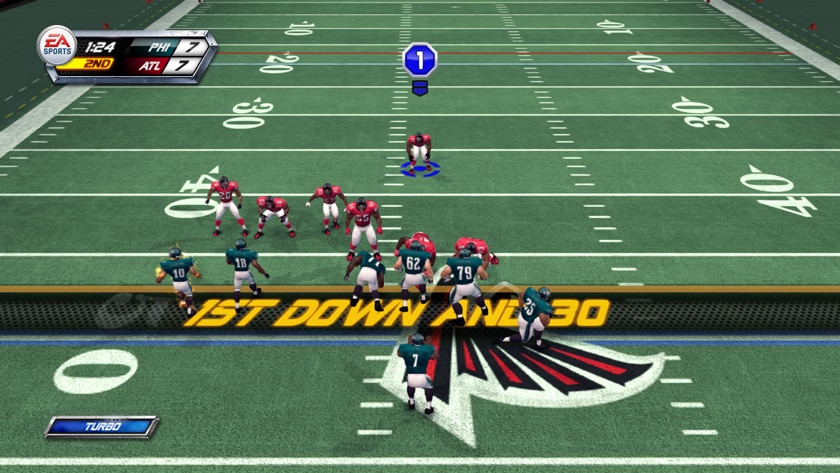
    NFL Blitz

    Types of Sports PC games you can play

    These sports adaptions for PC come in different flavors:

    • arcade 
    • simulation
    • management
    • multi-sport
    • sport-based fighting.

    Genre: Arcade

    Arcade-type sports games portray an unrealistic gameplay style, focusing more on scoring and having fun, without even trying to simulate the natural world and -gameplay. 

    Examples of Arcade Sports games include 

    Sports: American Football

    PC Game: NFL Blitz

    ‘” style=”position:relative;padding-bottom:56.25%;height:0;overflow:hidden;max-width:100%;border-radius:8px;background:#000;cursor:pointer;margin:1em 0;”>
    ▶ Play video (YouTube) – clicking will transmit data to Google. Privacy notice

    NFL Blitz is an American Football frolic that at least obeys the standard football rules.

    However, it is very flexible with fewer players and adjustable positions. It is an excellent game if you are looking for this type of pastime. 

    Sports: Basketball

    PC Game: NBA Jam series

    NBA Jam features players from all 30 NBA teams in a 2 – on – 2 arcade basketball competition. You can have a one-off with any team or play a classic campaign, beating the other teams in order to win the championship title. 

    In addition, it offers local multiplayer, connecting you with friends via Wi-Fi or Bluetooth, and online Multiplayer, guaranteeing many hours of fun in front of your screen.

    Genre: Simulations

    Simulations are much more realistic by design, focusing on every detail and replicating the exact characteristics of the sport. The concept is to provide complete immersion into the game.

    And with the advent of VR headsets, you will not know if what you are experiencing is real or a simulation anymore.

    Examples of Simulation type of Sports games are

    Sports: Soccer

    PC Game: Pro Evolution Soccer (PES)

    Pro Evolution Soccer

    Pro Evolution Soccer (PES) is one of the best emulations of the most famous sport on Earth for PC. PES offers you matches against the computer-controlled opponents or your real-world friends in Multiplayer.

    Furthermore, the Co-op mode lets you play with a friend on one team.

    The different game modes

    • exhibition
    • cup and 
    • career mode (solid to be the best), 

    are highly engaging and worthwhile.

    PES is considered to be a highly realistic soccer simulation.

    PC Game: FIFA

    Next up is FIFA. FIFA is the Goliath of soccer video games and sports games in general. Its popularity has even increased over the years. Heck, many soccer stars play FIFA for relaxation (perhaps because they can play themselves?)

    Soon, it will be interesting to see if the PES-“David” will be able to take FIFA’s place since FIFA is losing its FIFA name and many league licenses.

    FIFA offers similar features as PES but is known for its more arcade gameplay on and off the pitch, with slightly more complicated game controls. 

    Graphics, animation, attention to detail (player jerseys, emotions, reactions, spectator responses, arenas), and licenses beat all challengers, at least for the moment.

    You can play for any club in any professional league, including playing for your team in the UEFA Champions League. 

    FIFA gives you an all-around soccer experience and my personal favorite – for the moment.

    Sports: Basketball

    PC Game: NBA 2k22

    NBA2k22

    The NBA 2k franchise today is the gold standard for basketball games on PC, widely recognized for its near-perfect representation of basketball. 

    Its latest release, NBA 2k22, offers a rich, realistic gameplay with your performance affected by player rating. Also, compared to its predecessor, NBA 2k22 features improved graphics and presentation with a Career mode and other interesting features.

    Sports: Tennis

    PC Game: AO International Tennis

    ‘” style=”position:relative;padding-bottom:56.25%;height:0;overflow:hidden;max-width:100%;border-radius:8px;background:#000;cursor:pointer;margin:1em 0;”>
    ▶ Play video (YouTube) – clicking will transmit data to Google. Privacy notice

    “Australian Open International Tennis” is the best Tennis game available for PC today, offering you to slip into the shoes of today’s top players, play on famous courts with a high level of realism, and battle against a well-honed AI. 

    With the game developer holding the important licenses, you can play hundreds of real top players or – if you prefer – recreate yourself with the “PlayFace” tool. 

    The motion capture technology, various historical courts, and the exciting career mode give you an immersive tennis experience.

    And if you ever grow tired of playing against the AI, you can compete with friends for World Championship online.

    The game comes with full cross-platform functionality. Something I wish my favorite FIFA had.

    If AO International Tennis for some reason is not to your liking, other Tennis options for your PC include:

    • Virtua Tennis
    • Top Spin 4
    • Tennis Elbow 4

    Sports: Volleyball

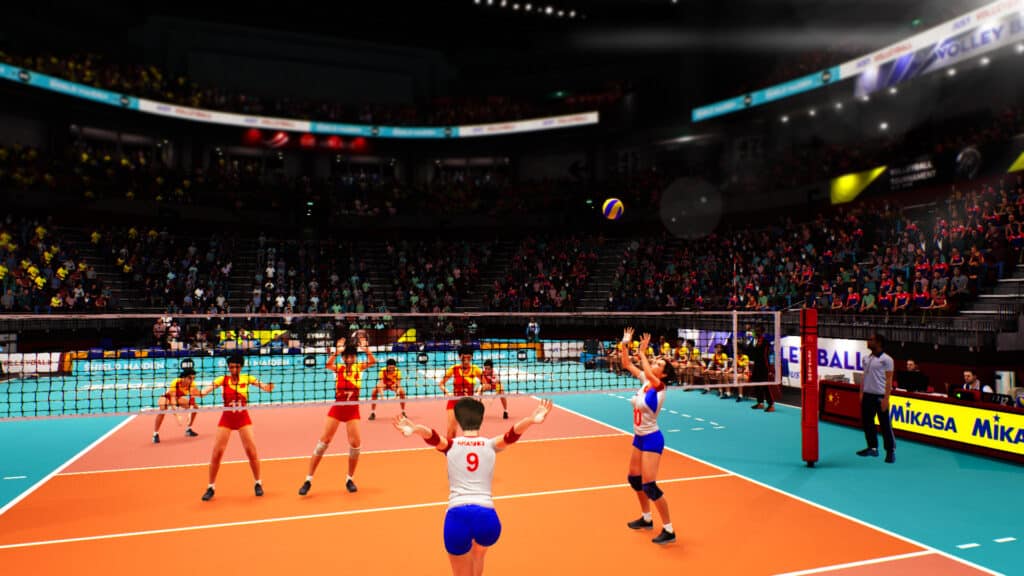
    PC Game: Spike Volleyball

    Spike Volleyball

    Classified as one of the best volleyball PC games, it features high-quality graphics reminding us of real, live volleyball. You can choose from 50 male and female teams, playing single against the computer or other human opponents online.

    Should you be looking for even more PC Volleyball games, check out this list:

    • Volleyball Unbound – Pro Beach Volleyball
    • Perfect Universe – Play with Gravity
    • Super Volley Blast

    Sports: Racing

    PC Game: Forza Horizon 

    Forza Horizon in-game

    Forza Horizon is a brilliant racing game receiving positive reviews constantly. Its atmosphere keeps you glued to the screen with fascinating details like varying track surfaces, seasonal changes, and an excellent weather forecast. All of which influence your racing game.

    Coupled with fascinating racing seasons, I am sure you will enjoy Forza Horizon.

    In case you still can’t get enough of racing on your PC, you should give these games a chance:

    • F1 2022 – We will cover this game on its own page.
    • Need for Speed – an absolute classic, spawning its own movie blockbuster

    Sports: Golf

    PC Game: PGA Tour 2k21

    The PGA Tour franchise is renowned for its beautiful aesthetics, amazing graphics, soundtrack, realism, and fantastic gameplay. The ambiance is tailored after the one and only Tiger Woods himself. 

    So slip into his Golf shoes and grab a driver.

    Other amazing golf games to mention:

    • The Golf Club VR [VR headset mandatory]
    • The Golf Club 2019

    Sports: Baseball

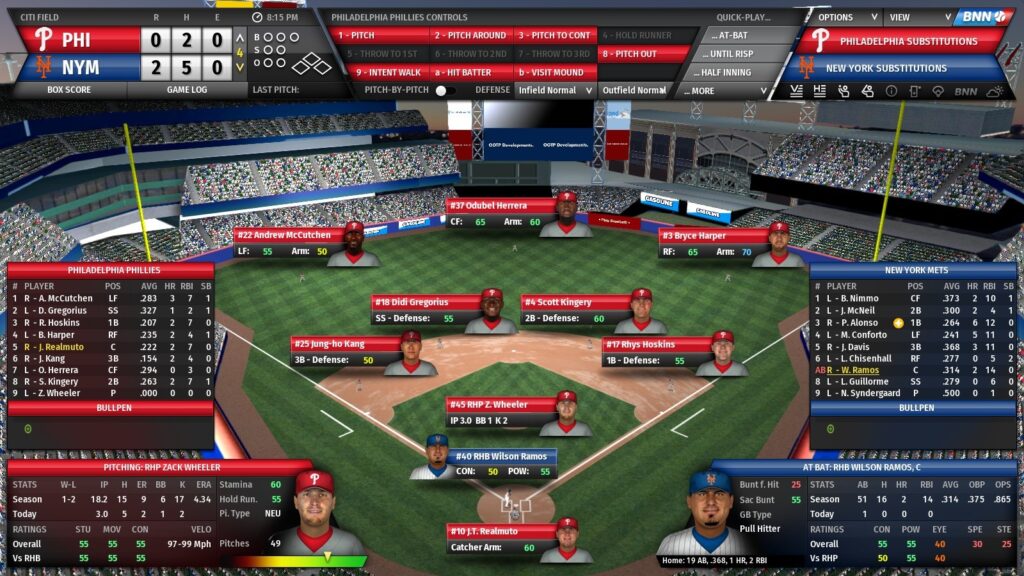
    PC Game: Out of the Park (OOTP) Baseball 21

    OOTP 21

    Out of the Park creates a realistic baseball world with well-captured, immaculate motion animation, arena, and game atmosphere, with players developing, reaching their peak….only to decline their abilities as they age. 

    But new prospects are always available. The circle of life …

    OOTP 21 is fully licensed by MLB and the minor leagues, giving you real-life experience when signing junior players for your team.

    You fully control the game’s inherent analytics by running complete analyses of players and their performances.

    So according to the logic of our structure, we could have put OOTP 21 under “Management” games, also.

    If you want to play against your friends, the Multiplayer mode allows you to do just that. 

    And if you are even more hungry for PC baseball games, then have a look at:

    And here find more PC Baseball games

    Sports: American Football

    PC Game: Madden NFL 19

    Madden NFL is a beautiful football game for PC with fantastic arena-, player-, and in-game animations. You also do not have to play alone if you don’t want to, as the included Multiplayer mode connects you with friends anywhere.

    Madden NFL is the top-recommended game if you want an impressive football gaming experience online or on the computer.

    Other football games you might want to check out include:

    • Pro Strategy Football 2018
    • Axis Football 2017

    Sports: Table Tennis

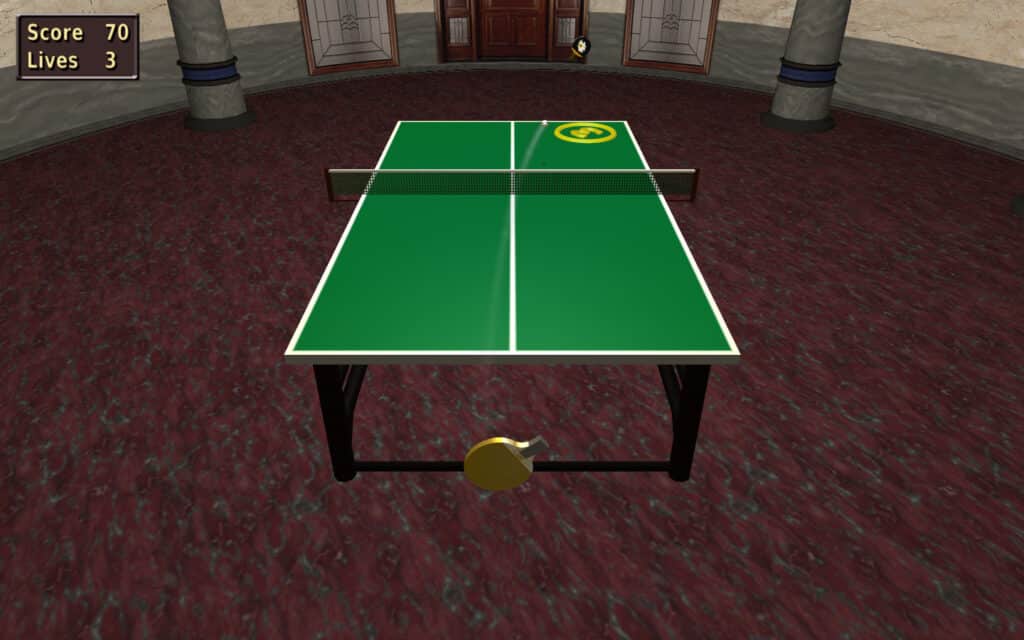
    PC Game: Table Tennis Pro

    Table Tennis Pro

    TTP features a 3D environment and an innovative control system, giving you surprising control over the shots. You also can play with friends via multiplayer or dual-player mode.

    Sports: Boxing

    our Resource if you are into Boxing Games for PC

    PC Game: The Thrill of the fight – VR Boxing

    ‘” style=”position:relative;padding-bottom:56.25%;height:0;overflow:hidden;max-width:100%;border-radius:8px;background:#000;cursor:pointer;margin:1em 0;”>
    ▶ Play video (YouTube) – clicking will transmit data to Google. Privacy notice

    This game takes its fascination from its proximity to real-life boxing, as even professional boxers use it as a training tool. The mandatory VR headset allows for a complete immersion into boxing. Black eyes included.

    If this ain’t enough to convince you to hit it, ahem, give it a shot, I honestly don’t know what would.

    Other good boxing games you can check out include

    • Real Boxing
    • Art of Boxing

    Sports: Hockey

    PC Game: NHL 22

    Arguably, NHL 22 is the best hockey game for PC, renowned for its stunning graphics, animations, the strong resemblance to real NHL players, exciting commentary, a brilliant AI, an offline and online career mode – all in all, a pretty immersive game to play.

    Genre: Sports Management

    Sports Management games do just that… make you the manager of the whole bunch. So you wear suits instead of a jersey and deal with the management side of sports.

    Some games also allow you to “manage” against friends in Multiplayer. 

    Various examples are

    Basketball Manager

    This unusual Basketball Management game is based on the currency called “Vitamins,” essential to unlock the game’s options. And since you pay with Vitamins, you should not be surprised that “Steroids” are part of the gear, also.

    I agree this is a rather weird game… in case this is not for you, but you would like to play a Basketball Management Game (click here)(https://pcplayerhub.com/basketball-games-pc/)

    You can find more Basketball Management games here.

    Football Manager

    ‘” style=”position:relative;padding-bottom:56.25%;height:0;overflow:hidden;max-width:100%;border-radius:8px;background:#000;cursor:pointer;margin:1em 0;”>
    ▶ Play video (YouTube) – clicking will transmit data to Google. Privacy notice

    In Football Manager, you act as manager and coach your team to the top, participating in various leagues worldwide. 

    FM feels natural with the various player acquisitions, team budgets, and deadline day euphoria, just as it happens in world football. 

    In addition, FM 2022 has modernized licenses and leagues with a plan for women’s football, giving players a profound soccer experience.

    If you love playing sports manager games, you can also give the following games a try:

    • Front Office Football 8
    • Basketball GM
    • F1 Manager 2022
    • Pro Cycling manager
    • NFL head coach
    • Tennis Elbow Manager
    • Eastside Hockey Manager

    Genre: Multi-sport

    Multi-sport games have multiple disciplines combined into one single game. 

    An example would be 

    • London 2012
    ‘” style=”position:relative;padding-bottom:56.25%;height:0;overflow:hidden;max-width:100%;border-radius:8px;background:#000;cursor:pointer;margin:1em 0;”>
    ▶ Play video (YouTube) – clicking will transmit data to Google. Privacy notice

    This official London summer Olympics game features the Olympic sports, including track and field events (discus throw, high jump, long jump), swimming, diving, shooting, archery, gymnastics … what they do during the Olympics.

    If you desire an all-sports Olympic feel, there’s your answer.

    You may also want to check out its Vancouver 2010 predecessor.

    Genre: Sports-based Fighting

    This genre includes both boxing and wrestling games. Noteworthy games would be:

    WWE 2k series

    WWE 2k is the official wrestling game available for PC. It has impressive visuals and gameplay, with various camera angles, player introductions, and signature moves, like a real wrestling showdown.

    Fight Night Champion

    This boxing game is equipped with authentic content, showcasing an accurate graphical replica of the sport, with a dynamic “blood view” for boxing–invoked injuries. 

    You can add dynamics to your player’s punches with the advanced gaming control and have a whole boxing experience. 

    To cap it up, you can harness your bragging rights in an online battle with friends and win the ultimate champion.

    Other famous sports-based fighting games that are worth your time include:

    • Mortal Kombat
    • Street Fighter
    • Tekken
    • EA Sports UFC

    Where can you find sports games for PC?

    These games can be found in known gaming stores. These are digital stores that allow gamers to buy and own games without having or needing a physical disc anymore.

    The leading sources are Origin, Steam, GOG.COM, epic games store, Ubisoft Connect, and Xbox Game Pass.

    Games owned by EA sports franchises (FIFA, Madden NFL, NHL, UFC) are commonly found on Origin. 

    OOTP can be bought on Steam or Mac AppStore Platforms. 

    Tennis Manager is listed on GOG.COM.

    Football Manager and Pro Evolution Soccer on Steam, epic games store, and Xbox game pass platforms.

    Steam is the most dominant storefront of them all. As such, players can find most sports games on this platform.

    Can you play Sports games on PC for free?

    Sports games can generally be classified into three distribution types:

    • free
    • freemium and 
    • paid games.

    Some games like Basketball management contain all three features.

    Free and Freemium games are usually played using a browser, while paid games are available for download from the Publisher’s site, Steam, or any earlier mentioned game storefronts.

    What do you need?

    To enjoy sports games on your PC, you would need one or more of the following components;

    • Joystick

    Used for sports games like Soccer (PES, FIFA), Basketball, car racing, tennis, and boxing. 

    • Keyboard
    • Gaming mouse

    Gaming mice might be needed for playing some sports games such as cricket.

    • Steering wheel plus pedal

    If you want to enjoy car racing games, this might be mandatory.

    • External Speakers

    Makes the game all the more enjoyable, with the enhanced audio effect giving a live feeling. Honestly, who wouldn’t want to hear the cheering crowds?

    Can you play with friends?

    Many sports games feature single players, dual players, multiplayer, co-op, and cross-play.

    This is true for games like Soccer, Basketball, Car racing, boxing, wrestling, baseball, and Sports Management. 

    In addition, other sports like Golf, Basketball, Car racing, and sports management allow connecting with nearby friends via LAN connection. 

    With most games, you can also play with friends online via Multiplayer.

    Sports games like Forza Horizon, Football manager, and Super Mega Baseball, to mention a few, have the cross-play (otherwise called cross-compatible or cross-platform) feature. This online multiplayer gaming feature allows multiple players from different gaming platforms and/or PCs to connect online and play with each other simultaneously.

    Additionally, PES, NBA 2k22, and FIFA have a co-op feature that allows players to work together as teammates against one or more AI-controlled opponents to achieve a common objective.

    Can Sports games be played on any Personal Computer?

    It is essential to consider the computer’s specifications before buying any game. The specifications decide if the PC is well equipped for the game to run, and even if it runs, you may not enjoy the experience if the PC hasn’t enough RAM or GPU power.

    Therefore, yes, sports games can be played on any personal computer if the computer meets the minimum requirements necessary for the effective running of the game.

    While it is advisable to own PCs with high specifications for excellent gaming experience and to own multiple games, the following should, however, be considered as minimum requirements;

    • Windows 7 or 10 (64 – bit) Operating System
    • Intel® core ™ i5, i7, or more Processor
    • 6GB or 8GB RAM
    • Nvidia GeForce GTX 780/AMD Radeon R9 290 Graphics card
    • At least 50GB of available space
  • All about Stellaris Modding – Interview with akeean

    All about Stellaris Modding – Interview with akeean

    I had the opportunity to interview the developer akeean of one of my favorite mods HexGrid Overlay.

    HexGrid really helps you enjoy Stellaris in co-op mode, a game mode not natural to Stellaris.

    In this interview, I learned a lot about the – to me – secret world of the modding community.

    I hope you enjoy this interview as much as I did, learning about the motives behind investing hundreds of hours into a mod, the rewards, and the delicacies of modding itself.

    “Q” is my question and “A” is his answer.

    Q: Please tell us a little about yourself and your background? You are a Stellaris modder, are you a coder in your real life? Is knowledge of coding necessary?

    A: I’m a web developer, so I can code. I’ve been modding games way before even starting to do programming. For most games, you don’t need programming knowledge, but it really depends on what it is you want to create. 

    But you have to be ok with reading a lot of the editable files to understand what file is responsible for what.

    Q: Why do you mod for Stellaris? What is your relationship to this game? Do you also do mods for other games?

    A: I started modding for Stellaris 6 years ago because at release there were some things of the game that annoyed me & were very easy to change.

    Mod support is something that I look for in games. There is always a thing or two that I’d like to change about a game when I play it.

    Most of the time I just enjoy tinkering & don’t really expect to create anything worthwhile. You know, like those people that take apart their mostly functioning toaster & then kind of put it back together (or not and it ends up on a pile of ‘projects’).

    Q: What mods did you develop and why? Do you develop these mods based on your personal needs and what you feel the vanilla game is missing? How much time do you spend on developing and updating a mod?

    A: I have created a bunch of mostly small utility mods. Only a few of them are shared with the public. Sometimes it’s just to fix something that annoyed me about the game, other times to add some small thing that makes the game more enjoyable to me or a friend.

    On release (and for quite some time) the game had a big imbalance centered around the cheapest type of ship, the corvette. Basically, its base cost was way too cheap relative to its components, so by far the most effective way to play was to just put 3 of the lowest tier lasers on it and nothing else, never upgrade it even if you had the technologies.

    Then you’d just build hundreds of it and drown your enemies in corvettes (which got very laggy). I felt that advanced technologies should be vastly more effective and made my own tweaked version of the ship classes and components.

    This was one mod I never publicly published since it can be a hassle to keep updating a mod over time, especially as this was a part of the game that would see frequent changes by paradox. There were also a lot of more ambitious mods to tackle ship balance, so I preferred to keep this one to myself & the group I played coop sessions with.

    One public mod that I created is the HexGrid Overlay. This one projects a honeycomb over the galaxy map with a 4 digit identifier for each tile. 

    Stellaris Mod Galaxy OverlayGrid
    Stellaris Mod Galaxy OverlayGrid

    This allows cooperating players to easier talk about regions of the map without referring to clock orientations (that system in the middle of 9 o’clock’, which could be 10-50 systems to look at) or very coarse compass directions. 

    Instead, I made each tile small enough that it covers about 10 systems, so it’s much easier to narrow down the scope of attention. (“My starting location is on grid 0110, at the border to 0101”, for example).

    We used this a lot when starting a new game to communicate each other’s positions, as players do not start with a shared vision, as Stellaris does not have ‘teams’. This made it easy to decide if we wanted to go ahead with a game or restart it to reroll the map & starting locations, but it also helps a lot in war coordination.

    I was inspired by it from the ‘war room’ in Babylon 5, which was a giant wall with a regular square grid projected. I chose a hex pattern instead since Stellaris species can also be insect hive minds, robot squids, etc who might not choose squares.

    This mod took me an afternoon to think up and maybe two to get in the game & working. I was more about thinking about how to label the hex tiles & making the image than wrangling any mod-related technical hurdles. There were other mods that had solved the map projection part I could use as a reference

    The most labor-intensive mod I did was during the Stellaris 2020 ModJam, which is an Origin that included a small Story and special game start condition. This was way more technical to me as it touched a lot of parts of the game I had no experience editing and wasn’t quite as straightforward.

    I think this mod took about 150 hours of my free time in which I developed the idea, made a basic version I tested & fleshed out more as I went.

    Q: I understand that Stellaris is by design extremely modding friendly? So Paradox Interactive wants the user base to change the game? Why would any publisher want this, does this not make developing updates and DLC harder for them?

    A: Stellaris is quite modding friendly, you don’t need any special software to change how the game works. Many games have their internals wrapped up in pack files that the community first needs to figure out how to open, extract & then wrap back together in a way the game can read it.

    Stellaris, in contrast, has most of its game-related workings as loose text files you can open with Notepad basically. (Although an actual programming text editor with Syntax highlighting is an immense help).

    I think Paradox mod support is a win-win situation. The openness of the game makes it easier for them to change the game with each DLC & patch. The way Stellaris is moddable, you can theoretically sit a creative CS student or intern in front of it & they can get you 30% of the input of a DLC, without using the expensive dev time of a senior engine developer who has a decade of experience of the highly complicated (risky to edit) C++ code of the game.

    Paradox’ Modding Strategy

    I think this openness allows Paradox to support a lot of titles with a small core team that focuses on underlying issues & set the frameworks of new moddable titles to build on.

    They can also look at popular mods as a kind of market research to see what features to add and the game becomes a lot ‘stickier’ without them having to invest a lot of developer hours.

    Mods also encourage the purchase of DLCs. Maybe you don’t care about Apocalypse DLC, but hey there is a Star Wars mod that you love, but in order to get the planet-killing functionality of the Death Star you need that DLC (one of the mod guidelines is that your mods can not ‘unlock’ things that are locked behind a DLC).

    Making a game mod-friendly does take extra consideration and work (Paradox has one dev that puts considerable effort into adding modding wishlist items with each patch), but I think if it doesn’t endanger your business model, it will lead to a better product.

    A developer with a ‘modding culture’ also has big advantages with recruitment & onboarding, as with Paradox’s example, they already have great public & up to date documentation for the game code side of things and they can (and have!) even recruit modders.

    Some of those know the game pretty well. Even if your new hire has zero experience, you can make them start with the easy stuff that is covered by the mod wiki, so they get their bearings and don’t cost you 20h of a senior dev time with baby questions.

    Having mod culture also nets Paradox better bug reports & easier agile development as they can’t just muddle through with certain things as modders will often be the first to stumble over certain programming-related skeletons in the closet.

    A lot of modern AAA games do not bother with allowing people to mod in order to increase monetization. Ubisoft for example is an example of this.

    With Assassins Creed Odyssey they reduced player progression speed once the reviews & Metacritic scores were in [with update 1.14]. This was so they could go on and sell players time-limited ‘XP boosters’ or resource packs while they made the game grinder with each patch.

    akeean is referring to this debate about Ubisoft nerfing the rewards to, as suggested by some players, increase the microtransactions from players ("Disgraceful nerfing the original single player economy to try and make you buy the microtransactions" - see "Mr Boba Jango" in the videos comments)

    They had the code of the game made unmoddable & took countermeasures to prevent memory hacking & tweak those progression rates without tweaking game files.

    Q: How does modding work? I mean, is there a programming language like PHP? Or is this game specific? Are there handbooks on how to mod? Self-taught?

    A: It really depends on the title.

    Often there is a similarity between games running in the same engine. For example Epics Unreal Engine is very different to mod than Paradox Clausewitz.

    You often also have to distinguish between game code and engine code. Game code does stuff like tell the game how much damage a hit with a crowbar does versus a rifle or what item a closet with random loot mat contain, while engine code handles the far more complicated calculation of hit detection or graphical rendering mostly because those need to perform orders of magnitudes faster than most functions of game code.

    Engine programming is often done in C++ and is usually not accessible to modders, while many games use LUA or a similar script language for their game code.

    Script languages are far more human-readable and easy to learn than lower-level programming languages. Often that’s also where you’d start when learning to program.

    For modding Stellaris, the best place to start is the Stellaris wiki modding article. It has documentation about most aspects (the wiki is also an asset if you are new to the game in general and want to know how things work in detail).

    I’d also recommend you get Visual Studio Code and install the CWTools plugin, which is made for Paradox games and helps you to spot syntax errors in the Paradox scripting language and offers auto-completion.

    For 2d textures, PaintNet can output the file formats that Stellaris needs.

    3d assets can be created in blender and exported through a community-provided tool.

    Q. is there a modding community with your own forums? Or is this more like a lonely hobby? I read that, for example, the Star Wars mod needs a complete team? Can people like you make money modding? What is the reward, emotional or financial?

    A: You can make mods on your own, but you need to set the scope of what you want to create accordingly. The biggest newbie mistake is to try to make something too big or too ambitious in relation to what can be modded in a game or the necessary skill required.

    I mostly mod for myself. I just get more out of a game this way. If I feel something I made is remarkable enough that others could enjoy it or it would help others over a pain point, I might share it. For me the reward is emotional.

    The Star Wars and Star Trek mods have quite big teams of a dozen or maybe more contributors. Those mods are very interdisciplinarity, as they add music, 3d and 2d art, solid writing, and complex events on to off the sheer scale of the project.

    It’s hundreds of files in either of those projects and I think they required some special program to generate the static galaxy map that is canon in those franchises instead of a vanilla spiral galaxy with randomly placed empire homeworlds.

    There is a Discord Server called the Stellaris Modding Den, where modders can exchange Ideas or help each other out. Many big projects have their own channels in there for bug reports. 

    Making Money with Stellaris mods

    Making money with mods is a bit of a touchy subject. Neither the Star Wars nor Star Trek mods could ask for money for their mods and if they did either Paradox would shut them down or Disney/Paramount would eventually do it were they to end up on their radar. Trademark and copyright laws are to blame.

    If you make a fully original creation that you own (i.e. not using the universe that some other company owns, like Star Wars) and have a Patreon or similar I think there should be no problem with people supporting you there.

    Whatever game you mod for, you should check if the company owning the game has a modding policy and what it allows you to do. Some don’t let you link Patreon in the workshop, for example.

    Don’t expect to make much money from this, at least with Stellaris. Even high-profile creators with 100k subs don’t make more than $100 a month on their Patreon.

    Other games are better for monetization.

    Paradox has recently worked together to even have modders create the content for a set of official, paid DLCs in Surviving Mars. Those were cheaper than regular DLCs for the game and were each made by prolific modders of the game. I suppose the modders were paid for the DLCs. No idea if it was a % split or flat amount.

    Stellaris Updates & DLCs and Mods

    Q: I understand that each mod needs also to be kept updated to keep up with the frequent Stellaris updates?

    A: With Stellaris getting changed quite a bit with each patch, this means that a mod changing something that has been changed by a patch might no longer work.

    Also, Paradox keeps changing and improving their modding API and scripting language, this means even mods that don’t touch things a patch overhauls might stop working.

    Paradox usually (rarely) changes their API and language to improve performance or give modders more control over the game.

    Some mods can be more resistant to those changes if they affect things in the game that don’t get changed a lot. For example, mods that change the color of the center of the galaxy in 2018 will probably still work, even if the game warns you for them to be outdated.

    To start a new game on the day of a new DLC and keeping outdated mods enabled is a recipe for disaster. It can take some time for modders to test all of their mods with the new version and update them to not cause problems.

    Going to a mod page the day a new DLC or patch releases and commenting “update pls” is why some modders with a lot of mods deactivate comments on their mods.

    Most of us that spend hundreds of hours modifying the game follow the development of the game closely. Usually, we know there is a new patch. It’s just that when you have dozens of mods, testing and updating take time that we might not have at the moment.

    If there is a new patch that breaks your mods (or has too many bugs on its own), you can always roll back your version of Stellaris through Steam. (In your library, right-click a game — Properties… — Betas — Select the previous version from the betas dropdown, having “none” selected means you will get the latest official version.)

    Steam Workshop

    Q: What is the Steam Workshop?

    A: Publishers can choose to enable the Steam Workshop for a game.

    If they do, this means they have integrated a mod uploader so modders can list their mods on the Steam Workshop page for a game.

    Anyone that owns the game through Steam can easily download mods from there by subscribing there. Steam will then keep the mod updated for you. Usually, this means the game in question has a mod selector in its launcher or main menu.

    If a game has no Steam Workshop integration, or if you don’t have the Steam version of a game (i.e. You have the GoG or Gamepass version), you are not completely out of luck.

    There are websites where modders can list their mods outside of Steam. Usually, this is more effort for the modders and anyone wanting to use those mods.

    Steam Alternative Nexusmods & Paradox Mods

    One of those sites is Nexusmods, I think they even have a tool that can keep your mods updated. Paradox built their own Workshop called Paradox Mods, which also updates any subscribed mods.

    They still have a bit of work to do, as their platform does not yet have collections as Steam does.

    Generally, the Steam Workshop is the place to be if you enjoy mods. For this reason alone I usually own my games on Steam.

    Q: Can u tell us more about your mods? What was your motivation? Where can our readers find these?

    A: I’ve already mentioned HexGrid and my Modjam mod “Shielded Origin” further up. There are a few other small fix-mods that may or may not be outdated.

    Here is a link to akeean’s Steam workshop

    Why do you mod?

    Usually, when I play and something bugs me enough I tab out and see how it works and change it to my liking. Most of the time I don’t publish my creations or at least not publicly.

    I don’t want to bother writing descriptions or deal with people running into bugs (that may just as well come from them combining it with whatever other 50 mods).

    For example, when playing with a friend, he was playing the Calamitous Birth Origin with his Lithoids.

    They can build special colony ship asteroids that they crash on planets. This is cheaper and faster but creates a blocker on every planet colonized with it.

    What my friend didn’t realize was that the blocker on new colonies was different from the one on his original homeworld. So he ended up suffering from low habitability and unrest in dozens of colonies.

    Not wanting to lose a session we were already a few hours in, I just made a quick fixmod that changed the blocker on new colonies to be more like the one on his homeworld and not cost like 10% habitability.

    Normally I would not have set it to be visible to the public, but I was inspired and slapped a random image on it, so a few people ended up using it.

    Q: Do you have any idea how many mods are there for Stellaris?

    A: There are about 24,000 mods for Stellaris in the Steam Workshop. But a lot of them are probably no longer compatible with the current game version…

    Favorite Mods

    Q: In a recent poll many Stellaris players answered that they keep their mods a secret. That surprised me… any idea why that is? Why would that be a secret? What mods do you like and use personally … if that is not a secret?

    A: I’m not sure. Maybe they don’t want to admit to running anime-girls, fursona, or vaguely ww2 axis empire mods? There are some weird mods in the Workshop.

    My modlist changes with every version, due to the game changing.

    One mod that keeps getting updated and that I enjoy is Amazing Space Battles. This makes combat look a lot better and more dramatic, without really changing the game balance. I also use the related mods for it linked on the mods page.

    Another one of my favorites is Downscaled Ships. This makes spaceships look smaller in relation to the solar system and planets.

    In vanilla, a corvette is about the size of a moon and big fleets have some ugly clipping going on as they can’t fit into the same space the game wants them to be. Really ruins the optics of the game.

    Homeworld solved this problem in 1999 by dynamically changing the scale of the ship depending on the zoom level. But this doesn’t seem important enough to Paradox and can’t really be modded in.

    So the closest “fix” we can get is to just scale down all of the ships that the models are just smaller. I think with this mod, a Titan is about the size of a vanilla corvette. You can still zoom in more and get the same details visible, just with a bit more space between the ships zooming around.

    If you use any modded shipsets, you’ll need a compatibility mod (that usually needs to be below those mods in load order), otherwise, the ships from the custom shipset mod will look gigantic compared to the downscaled ones.

    Tips for Starting Using Mods

    If you are new to modding Stellaris, you should find a list of mods that are known to work together, rather than subscribing to random mods. If mods conflict, it can lead to crashes, broken savegames, severe performance degradation, or “unexpected synergies”, rendering the game incredibly easy, or impossibly difficult.

    A good modlist can lead to amazing and spectacular sessions, so it’s well worth trying out mods.

    Can You Play Stellaris Multiplayer with Mods?

    Q: Do mods work with Multiplayer in Stellaris, like the host’s DLC are expanded to all co-players?

    A: Yes, you can run mods in multiplayer. No, it doesn’t work like the Host DLC authority. Clients must have the same checksum as the host.

    All players need to run the same non-ironman save mods in exactly the same load order.

    Unfortunately, there is no way to share lists of active mods from the game’s launcher.

    Many people are waiting for that feature to eventually arrive with paradox mods. You can have collections in Steam to make subscribing to them easy and get them downloaded and available in the game launcher, but you still need to activate them and potentially drag them into the right order.

    If you want to use different mods in a multiplayer session than in a concurrent single player session, be smart and create a playlist for either of those in the launcher.

    This way you can easily swap the active list before you start the game. Also, make sure to actually swap to the right playlist before starting the game.

    Ironman & Ironman Compatible Mods

    You can run any ironman-compatible mods individually without them affecting a multiplayer session. There are only very few mods that are ironman save (usually UI mods and graphical tweaks).

    Mods & Checksum

    What is “the checksum”? The game displays a string of letters and numbers near the version number (or as a tooltip of the version, I don’t quite remember right now) in the main menu.

    Any mod that changes the game balance or adds new things, will cause a change in the checksum.  There are some mods that don’t modify the checksum, those are usually called “ironman compatible” since the game only lets you collect achievements with the vanilla checksum. Same checksum = same game version with same active mods in the same order and same version of mods.

  • What is the best Stellaris DLC?

    What is the best Stellaris DLC?

    Stellaris, since its inception, has been expanded with attractive add-ons or so-called DLCs (Downloadable Content). These are not to be confused with the regular free updates the game receives periodically. That said, a release of a new DLC and a new update mostly go hand in hand.

    Also, do not confuse DLCs with the free but user-generated mods (modding – user-generated add-ons to change the game, i.e., convert the game into a Star Wars game – more on that in another post).

    To find out about the ultimate, best Stellaris DLC, we polled the community of Stellaris fans with the question: “If you only could own one Stellaris DLC – which would that be …and why?”

    62% of the participants expressed that Utopia is the single best Stellaris DLC, followed by Synthetic Dawn with 9.2%, Ancient Relics with 7.4%, Apocalypse with 6.1%, Federations comes in fifth at 4.3%, and lastly Nemesis with just 1.8%.

    The best Stellaris DLC still is Utopia by a fair margin

    What Stellaris DLC is worth it?

    Today you can choose from more than a dozen Stellaris DLCs. Still, our participants named Utopia the most “worthy” DLC.

    But Utopia does not rank as the most worthy Stellaris DLC in our poll only: Steam does so, also a close second to the Species Pack Aquatics.

    I have like half of them [the DLCs], but Utopia and Ancient Relics are by far my favorites.”

    Ömer Güler – Poll participant

    Then why is Utopia still the best “relevant” DLC on Steam?

    We can group Stellaris DLCs into three distinctive groups:

    • Species Pack: Adds new species and origins to the game
    • Story Pack: Adds new storylines to the games, for example, playing the game as a synthetic empire
    • Game DLC: the most game-influencing DLCs – adding complete new “ideas” to the game, like playing as Megacorps or the idea of building Federations

    Read more about Stellaris:
    What is the best Stellaris version?
    Is Stellaris Good for Single Players?
    Stellaris Ships: The Beginner’s Guide and Tips
    Does Stellaris have a Coop- Mode [how-to instructions]


    From what I read and hear, the Aquatics Species Pack made it to the top of Steam’s list primarily because of its amazing graphics. Not because it improves the gameplay so much. That is also not the aim of a Species Pack DLC.

    Aquatics Species Pack comes with beautiful graphics

    The “Game” DLCs are what move the needle concerning game-changing changes.

    So with Aquatics being much younger and not having much influence on the gameplay itself, Utopia is likewise voted as the best “game” DLC on Steam…albeit its age.

    Best Stellaris DLC Table

    Finally, combining our poll with the Steam results, we reach the following table:

    DLCRelease DateSteam Ratingour Poll: one
    and only DLC
    Overlord DLCMay 2022
    Nemesis DLCApril 202141% positive1.8%
    Aquatics Species PackNovember 202189% positive
    Necroids Species PackOctober 202054% positive
    FederationsMarch 202072% positive4.2%
    Lithoids Species PackOctober 201955% positive
    Ancient Relics Story PackJune 201977% positive7.2%
    MegacorpDecember 201858% positive
    Distant Stars Story PackMay 201865% positive
    ApocalypseFebruary 201864 % positive6%
    Humanoid Species PackDecember 201749% positive
    Synthetic Dawn Story PackSeptember 201771% positive9%
    UtopiaApril 201780% positive62%
    Leviathans Story PackOctober 201673% positive
    Plantoids Species PackAugust 201661% positive

    What is the best Stellaris DLC PCPH poll & Steam ratings combined

    Verdict: The one DLC to own is Utopia.

    So what makes Utopia so popular after all these years?

    What is it about Utopia that Stellaris fans still call it their “cannot-live-without” DLC after all these years?

    What does the Utopia DLC add to Stellaris?

    One of our poll participants, “Riley” said the following about Utopia’s importance and the necessity for Stellaris:

    Utopia was the first expansion and was kind of made with a different kind of philosophy than the others which has resulted in it being more or less mandatory to properly play the game.

    Riley – poll participant

    Utopia was the first “game-changer” DLC and can be seen as a mandatory (technically, you are very fine with the vanilla game) extension for any hardcore Stellaris aficionado.

    Utopia adds Ascension Perks

    For example, Utopia adds new, exciting Ascension Perks to the game.

    The vanilla game already featured the concept of Traditions, representing the cultural traits and strengths of an empire. Ascension Perks add to this by letting you determine the ultimate development goal of your species, the endgame of its evolution.

    During the early game, the “traditions” can be headed and developed by the player to gain a technological, military, or economic advantage over the other empires. A new Perk slot opens when a new tradition is “developed” by finishing all five development steps (each costing Unity).

    after developing a tradition, a new Ascension Perk slot opens

    Utopia brings new intriguing Ascension Perks to the game. You can now destine your pops to morph into uber-beings:

    By choosing one of Utopia’s new Ascension Perks, you decide about your species’ ultimate socio-economic and cultural aim and future: Does your species stay biological and extend gene manipulation?

    Will you develop your species to Psionic power and become metaphysical? Ultimately reaching a state of being able to contact the transcendent uber-beings, The Shroud?
    The envy of many Burning Man attendants is yours!

    Or is your empire determined that the flesh is weak and sets its ambition on leaving its physical form behind and transforming itself into artificial life – cyborgs and ultimately robots?

    Utopia adds Megastructures

    Utopia adds societal development perks, but it also comes with the gorgeous technology of Megastructures.

    Did you always publicly talk of building a Dyson Sphere? Eat this, you petty critics! I told you!

    Stellaris Utopia brings Dyson Sphere

    Next to expanding on the options to enslave or extinguish other civilizations, some new traditions pushing the limits of our morality and playing Caesar subjugating pre-FTL societies (who needs a First Directive?), Utopia adds the ultimate Norman Bates way to play the game:

    If you are tired of all these petty, boring, and hindering ethics, why not play as Hive Mind: All that is not you is food… to hell with morality!

    What Stellaris DLC should I buy first?

    We heard something like the following from the poll participants. Remember, the question was, “If you only could own one DLC, which would that be and why”:

    Utopia: Megastructures, habitats, Hive Mind, Ascension perks

    Anthony

    Utopia – megastructure

    Zenon

    Utopia makes R[ole]P[lay] in the game viable.

    Kim

    Utopia and federations are the major game-changer.

    Victor

    Utopia! Distant Stars is a close second.

    Chris

    Not sure if it changed, but in utopia you have the 3 ascensions, so I would start there. I loved the leviathans dlc because it brought a lot of life to the galaxy, and the war in heaven.

    Fede

  • What is the Best Stellaris Version?

    What is the Best Stellaris Version?

    Stellaris, since its inception, has been updated quite often, and significant changes in game dynamics with update 2.0 leave many players long for older versions’ features.

    Some claim Stellaris 1.9.1 Boulle was the peak version because its unrestricted FTL travel offered better opportunities for warfare with enemy empires than the newer versions. But 3.4 Cepheus is much more stable and introduces a novel, better way of FTL travel via Hyper Relays.

    I got hooked by the game when the “Dick” update reigned, named after the influential Sci-Fi writer Philip K. Dick (i.e., Blade Runner). So to test and see which Stellaris version offers the best game experience, I dug out the famous Stellaris 1.9 and just tried it.

    Was version 1.9 Stellaris’ peak?

    A watershed moment for Stellaris was the update from 1.9.1 Boulle to 2.0.5 Cherryh when Stellaris space travel received a substantial overhaul. Unfortunately, many say this was a significant step in the wrong direction, claiming that with version 1.9, Stellaris has reached its prime and that the new game dynamics made the game drastically less enjoyable.

    Stellaris <= 1.9.1 did not limit FTL movement in space – you could jump anywhere.

    Until 1.9, FTL travel was unrestrained. The player could send his ships anywhere without restrictions – over the complete galaxy if necessary (but still jumping from system to system, as is the case in the modern game).


    Does Stellaris have a Coop Mode?

    All about Stellaris’ Multiplayer

    Is Stellaris playable with DLC?

    Is Stellaris still worth your time and money?


    The game already had hyperlanes as an option in settings, but these weren’t mandatory.

    Also, there were two other options for interstellar travel: Wormholes and Warp-Drives.

    Stellaris 1.9 vs. 2.0

    Stellaris 2.0.5 made hyperlanes the only FTL option. Hyperlanes define the connection between two systems, like a road determines the way between two houses. And you, the player, can only see these hyperlanes and hyperlane-crossings three systems ahead, as long as you have not traveled them.

    Stellaris 1.9 generates Star Trek feeling

    Many early players of Stellaris longingly look back to the days when space travel was unrestricted. Today you can not just send your science ship into deep space and see what they find:

    pre-version 2, you could sail to any system you wanted to – as long as you did not encounter an enemy fleet on the way

    And I must say, even though I joined to play the game much later than 1.9, I get the idea. So I partly understand those stuck on 1.9.

    Frankly, playing the game in the 1.9.1 version feels different from the modern versions. I felt like a character in Star Trek “going boldly where no one has gone before.”

    I freely ordered my science ships to cross the galaxy and explore deep space. It felt strangely exciting, different from the modern game’s more regulated approach.

    On their voyage from system to system, I held my breath about what they might encounter so far away from home.

    Honestly, to “boldly go where no one has gone before” was more exciting than the modern system of hyperlanes. At least in the beginning. It also has downsides. We will come to that later.

    There are also other differences in gameplay between 1.9 and 2.0+. Much in 1.9 looked less evolved and less complicated. It honestly felt like visiting one of the game’s early ancestors.

    The game had much fewer options and was missing any fleet management capabilities. Alloys weren’t invented yet, so I had difficulty finding the spaceports and shipyards. They were not listed in the Outlier. 1.9 also allowed for the modification of civilian ships in the Ship Designer.

    Construction ships could build Outposts in any surveyed system, and the graphics of star systems seemed much nicer done, though I might be wrong here.

    nice graphics of Barnard’s Star version 1.9

    How warfare changed from Stellaris 1.9 to 2.0

    The introduction of hyperlane-only FTL travel resulted in much higher predictability. It focuses military strategies on chokepoints: An attack on an enemy can only be performed via very few hyperlanes into his system. If the opponent defends these few central chokepoints skillfully, any invasion might be doomed before you can claim any planets.

    In contrast, before Stellaris 2.0, space travel had no limitations, you could attack any empire from everywhere, and it was impossible to build strategic defenses.

    So, with the introduction of hyperlanes FTL, it became highly predictable how the enemy must attack. Unfortunately, it seems this decision by Paradox created unhappiness among the players, changed warfare, and demands for implementation of the old FTL and Warp systems.

    Why Paradox changed Stellaris’ FTL travel

    The question remains, why Paradox Interactive chose to change the game so drastically. The developers of Stellaris answer this in their Dev Diary blog, Ep. #92:

    • Better performance through caching and unified code (Wormhole FTL in particular is a massive resource hog in the late game)
    • Warfare with a distinct sense of ‘theatres,’ advancing/retreating fronts and border skirmishes

    So the multitude of FTL travel options (FTL, Warp, and Wormholes) created so many possibilities of attack and countermeasures that, on the one hand, for the average player, it becomes impossible to handle. On the other hand, all these options over time overburdened the gaming hardware, slowing down the game.

    Paradox decided to simplify the game and give players the option to fortify their empires, having the opportunity to amass huge fleets at these choke points to either defend them or conquer them.

    The alternative: Disperse your fleet over your whole empire – the enemy could appear out of nowhere anytime and conquer your Starbases and planets.

    So I agree that the decision by Paradox to channel FTL travel by fixed hyperlanes creates a more balanced game with the option to experience massive fleet battles … just my thing!

    Stellaris 3.4 Cepheus: Hyper Rays Technology

    With the 3.4 Cepheus update, the dispute is settled once and for all. Introducing a new Hyper Relays technology that your construction ships can use to build “highways” to the stars.

    Galactic Map with Relays
    Stellaris Hyper Relays technology

    This technology speeds up travel massively, and you will not want to go back.

    Stellaris 1.9 Download

    But in case you want to test for yourself if you like 1.9 better than the actual versions, here is how to do it:

    • in your Steam library, right-click on Stellaris
    • choose “Properties”
    • choose “Betas”
    • enter “oldstellaris” (without the “”) into the field under “Enter beta access code” and click on “Check Code”
    • now you will be able to choose versions pre-2.0 in the drop-down menu above
    • Steam will load that version, and you will see in your libraries list “Stellaris [1.9.1]
    • Click on PLAY

    I am looking forward to your verdict … is 1.9 really better? Does 3.4 Cepheus blow older versions out of the water… share below in the comments or on our Facebook page.

  • Is Stellaris Good for Single Player?

    Is Stellaris Good for Single Player?

    Stellaris is an excellent game for single-player aficionados. Though it does not come with a campaign mode, the plain vanilla game and the Story Pack DLCs make it a phenomenal game to play as a single-player.

    Consider Stellaris not so much a game. Instead, see it as a story, a novel. A novel that you play. A story that you develop.

    Space mystery lovers created Stellaris with me in mind. At the core of Stellaris is the vastness of space and the curiosity about what lies behind our borders.

    This article will find out how we can make Stellaris even more attractive to the lone gamer. Frankly, playing on my own is how I prefer to play my games. And though I dig the single-player campaigns in all my games so far, I never missed this mode in Stellaris.

    As we see later, there are options to improve the experience for single-players, especially if you are a depressing researcher like me.

    Does Stellaris have a Single-Player campaign?

    Stellaris does not contain a single-player campaign mode like many other video games. Therefore, you won’t find a particular campaign story to play as a single player. Instead, each round begins with your Star System, one science, and one construction vessel. The player develops the empire from here.

    Stellaris is a complete campaign and story in itself – if you are the only biological player or share the galaxy with your friends.

    Is playing Stellaris as Single-Player fun?

    I played hundreds of hours of Stellaris in Single-Player mode, so I know for sure: Single-Player is honestly my favorite game mode. A game of Stellaris takes so much time to play that I like to save and pause the game anytime I feel too tired to continue. But, of course, that’s harder with a group of friends, who will have to leave at different times, rendering the game obsolete.

    When playing on my own, I decide when I call it a day. Sure, it is nice to play with your friends over the internet, even if you live far apart and you should do that. But, I prefer to play quietly by myself after a tough day in the office.

    Single-Player for the lost Scientist in you

    Also, a game with friends is more about chatting with them while playing against them. Only if you play on your own do you have the time to dig into the deeply hidden stories of the gameplay and can focus on being the researcher. And honestly, that is what the game deserves because it is full of details. It is impossible to follow all the story threads playing out even as a single player.

    For me, the thrill of the game is mostly the exploration, uncovering the secrets of an ancient universe. But I would say this depends on what you enjoy. As a kid, I always wanted to become a scientist. I missed that boat.

    Now, I love a good war with my neighbors more than anything else (in Stellaris, I mean). Call me belligerent. And it is a lot of fun to send your fleets against your fungi-playing friend.

    “The galaxy is ancient and full of wonders”

    Daniel Moregârd – Stellaris Game Designer

    All good. But then the confrontation with your friends is the only focus of the game.

    I more love the feeling of mystery that Stellaris entails. The excellent soundtrack also adds to the sense of adventure and mystery.

    And you can even enhance this immersion with add-ons.

    Stellaris DLC made for Single-Player

    Since it seems I am rather alone playing Stellaris, why not build Stellaris into something I like. Something for the never-became scientist, the researcher, the Indiana Jones in me – mystery and adventure.

    And for people like me, the single-player with affection for warfare, the programmers from time to time deliver special Story Packs as part of the release of DLCs (DownLoadable Content).

    ‘” style=”position:relative;padding-bottom:56.25%;height:0;overflow:hidden;max-width:100%;border-radius:8px;background:#000;cursor:pointer;margin:1em 0;”>
    ▶ Play video (YouTube) – clicking will transmit data to Google. Privacy notice

    These story packs sweeten the in itself fabulous gameplay of Stellaris with even more stories and things to do and discover. They add suspense, a sense of adventure, space archeology, and mysteries.

    Stellaris best Story Packs for Single-Player

    One of these Story Packs I could not resist is Ancient Relics.

    ‘” style=”position:relative;padding-bottom:56.25%;height:0;overflow:hidden;max-width:100%;border-radius:8px;background:#000;cursor:pointer;margin:1em 0;”>
    ▶ Play video (YouTube) – clicking will transmit data to Google. Privacy notice

    Ancient Relics adds the discovery of ancient races and artifacts and introduces archeology development “trees” to the game and mysterious precursor races and relics.

    Something the nerd in me digs.

    The other single-player Story Pack I have in mind is Distant Stars.

    ‘” style=”position:relative;padding-bottom:56.25%;height:0;overflow:hidden;max-width:100%;border-radius:8px;background:#000;cursor:pointer;margin:1em 0;”>
    ▶ Play video (YouTube) – clicking will transmit data to Google. Privacy notice

    What are the best settings for Single Player?

    Naturally, that depends significantly on what you are looking for in this adventure.

    Stellaris Single Player Settings for War Mood

    If you want a lot of warfare, when setting up the game, you should set the AI Aggressiveness on “High,” and you will have a lot of war on your hands throughout the game.

    Stellaris Single Player optimal settings

    Also, if you set “Advanced Neighbors” to “on”, you probably have an exciting time right from the beginning.

    If you also set the Difficulty to “Admiral,” the AI empires will be a tough nut to crack. And if you finally set “Scaling Difficulty” to “ON”, the advantage the AIs have against you will only grow.

    Stellaris Single Player Settings for Exploration Mood

    But if you instead pamper your repressed inner researcher or want to act out on your zeal for all things Economy, well, do the opposite. Reduce the number of Empires, create a large universe, prohibit Advanced Neighbors, and insist on low AI Aggressiveness. Finally, move the “Victory Year” to “never” and postpone the End-Game start to 2600 AD, and you can surrender to your kink ad infinitum.

    Stellaris Best Single Player Settings for Beginners

    I remember my first games of Stellaris like yesterday. I was overwhelmed. And no setting can change that – there are just too many moving parts to the game.

    But when you start your first game, you probably should choose the following settings:

    • choose a small galaxy, so you get fast feedback
    • prohibit Advanced Neighbors, so you have more time to learn the first thing
    • choose low AI Aggressiveness
    • play on Ensign or lower

    Get the hang of Stellaris, learn the ropes – it won’t be long until you start asking for more – then you will turn up the heat – Enjoy!

  • Stellaris Ships: The Beginner’s Guide & Tips

    Stellaris Ships: The Beginner’s Guide & Tips

    ‘” style=”position:relative;padding-bottom:56.25%;height:0;overflow:hidden;max-width:100%;border-radius:8px;background:#000;cursor:pointer;margin:1em 0;”>
    ▶ Play video (YouTube) – clicking will transmit data to Google. Privacy notice

    When you first play Stellaris, you will feel completely overwhelmed, I mean, I absolutely remember my utter confusion when I tried to make sense of all the pieces and parts that make up a Stellaris game. There are all these options, menus, and alerts.

    To bring order into chaos, and hope to the overwhelmed beginner, let us here look into all things “ships” in Stellaris. Let’s start with the civilian fleet.

    Since this is a beginner’s guide, we will deal with the military ships up to the Cruiser.

    Stellaris Ship sets

    But before we start I need to mention that I play mostly – us. Humans from the United Nations of Earth. So the images you will see below are from the “ship set” of the Earth “origin (as the different species are also called).

    There are many different ship sets (ship designs), and each origin has its design (the Aquatic DLC brings some beautiful new ship sets to the game). While the basic ship hierarchy (“Corvette – Destroyer – Cruiser – Battleship – Titan – Colossus) is the same for every species, the ship set’s designs will be different.

    So no matter if you choose to play a psychopathic zealot origin, the tips below still apply to your species.

    Stellaris Civilian Ship types

    You can distinguish between civilian and military ships. While you have no or nearly no influence on the “performance” and design of the civilian ships, Stellaris gives you a lot of influence on the military ship’s design and performance.

    Tip: When holding SHIFT while giving orders to your civilian ships, you can enter a list of orders, this helps a lot at the beginning of the game. Later. when your Technology department advances (left side under “Technology”) you can develop a technology that allows you to set your science ships on auto-exploration. Again that’s a huge relief.

    The civilian ships are:

    1. Science Ships

    Before you need anything else, you will employ your science ship(s). When beginning, immediately send out your existing Science ship to explore your surroundings. Each star system first needs to be surveyed by your Science ship, before you can send in your Construction ship to build a Starbase and a mining or research station.

    Tip: When you have enough resources available, immediately build more Science vessels, so you can explore faster.

    Earth Science Ship UNS Copernicus

    Also, your Science ships will stumble upon many artifacts left by other species and empires. The more you order your Science ships’ captains to research these “anomalies”, the faster your empire gains knowledge and sometimes even technology.

    But researching these anomalies, as Stellaris calls them, takes its toll on time. You will find that many of your Science ships are bound for Stellaris years fulfilling the tasked research job, but that part of the galaxy is not explored any further in the meantime.

    So relying on more Science ships lets you explore faster. I believe that you need to move your borders out fast because all your opponents are also exploring their surroundings and expanding their empires.

    list with your civilian ships on the right side

    The faster you survey the stars the faster your Construction ships can build Starbases for you, expanding your empire’s borders.

    To boldly go where no one has gone before does not come without risks. When you send your fearless researchers into unexplored space, they will often encounter hostile new species.

    Luckily the Science ships have a very high Evasion score, so they mostly can escape to an adjacent star system – IF you keep the “Fleet Stance” setting to “evasive.

    changing the “Fleet Stance” set to “passive” makes your scientists sacrifice themselves for your… what? honor?

    I am not sure why you would order an unarmed vessel to attack any hostile close enough, but hey, who am I to judge.

    It’s your empire.

    Remember that Science ships can be destroyed or rendered useless.

    I have never made my scientists die in the field of honor for me, at least not by ordering them to take point.

    Set to “evasive” my Science ships luckily mostly got away… as they are designed to.

    Hint: After some time your technology department will develop “Automatic Surveying”, allowing you to simply order your Science ships to survey every unsurveyed system automatically, freeing you up to tend to other more pressing matters.

    2. Construction Ships

    Stellaris Construction ship
    Stellaris Construction ship

    After you sent in the Science ships, you need to follow up with your Construction ships.

    Construction ships built the Starbases, expanding your empire and also the resource mining stations, as well as research stations.

    Whenever you build a new Starbase your borders expand and include this newly added star system.

    Construction ships are pretty low maintenance, you do not need to recruit a new captain now and then.

    Tip: When starting the game, you find one Science and one Construction ship in your fleet, ready to take orders. You should immediately send out these ships to explore the space around your system and build Starbases and mining and Research stations.

    3. Colony ships

    Colony ships are nothing you have to deal with. They are built and sent automatically whenever you decide to start a colony on one of the new habitable planets in your expanding empire.

    Transport ships are build by your AI when you choose to establish a colony – and have enough resources

    All you need to have when deciding to build and send a Colonization ship is enough resources (amounts depending on the species you are letting colonize the planet).

    4. Starbase

    my Starbase in Barnard’s Star – no military upgrades so far – still it also projects military power

    Without added weapons, defenses, and shipyards we could count the Starbase on this list of civilian ships. Though, this is not totally correct, as you see on the image above that even an unarmed space station yields military power, here 191 points.

    A starbase – as military ships – has armor, hull, and shields and can be upgraded with weapons to become a stronghold. They cost monthly upkeep in energy units.

    Starbases mark a star system as yours and allow you to build mining and research stations. I am still on the fence if I build a starbase in every system of my empire or only in the important ones (with resources or expanding my borders).

    So talking about Starbases we already touch on the area of the military.

    Stellaris Military Ship types

    For this article, we look at the ship sets from the plain vanilla game, not any DLC. We will touch on that elsewhere.

    Stellaris Ship Designer

    ‘” style=”position:relative;padding-bottom:56.25%;height:0;overflow:hidden;max-width:100%;border-radius:8px;background:#000;cursor:pointer;margin:1em 0;”>
    ▶ Play video (YouTube) – clicking will transmit data to Google. Privacy notice

    After you earned your first stripes, you will start to look deeper under the hood of Stellaris. Don’t overlook the Ship Designer, since it allows you to improve your ships or create ship variations that are a better fit for the tactics of your enemy.

    1. Ship type: Transport

    You do not have to deal with building Transport ships, these come with building Armies and ordering them to another planet. That is also the only use you have for this type of ship. You will need these armies to conquer planets.

    After recruiting an army, you find them on the right side close to the bottom of the Outliner (the right side menu) and can order them to go anywhere as you would with any other ship.

    Stellaris Army Transport Ships

    2. Ship type: Corvette

    The Corvette is your first and – in a way – your last ship. Sounds confusing? Well, it is literally your first military ship in Stellaris.

    But why should it also be your last, aren’t there any upgrades?

    Yes, there are, but over time you can upgrade the Corvette ship type so much, that its speed and evasive power will stay the backbone of your fleets, despite all the fancy cruisers and battleships you develop.

    Stellaris Ship experience Level

    Stellaris Ship Experience

    As you can see on the left, my Corvette, the UNS Kazakov, is built upon the Ladybird class (see video above), exerts a military power of 53, has seen a lot of battle (“experienced”), granting it 10% more damage inflicted on the enemy, has taken some beating (“Hull Points 354/400”), with Armor down to 1/65. The Shields have already regenerated (“100/100”).

    The UNS Kazakov costs me 2.76 units of energy and 0.62 units of alloys per month.

    She has FTL (Faster than Light) capabilities (can jump from system to system).

    The way the Ladybird class Corvette is auto-generated by my empire’s AI (I did not touch the design), the ship modifiers (the way the design is done) grant the ship:

    • Ship Fire Rate of +13%
    • +100 Hull Points
    • +15% Weapon Damage to the enemy
    • +10% Sublight Speed (within a system)

    As discussed in the video above, the Corvette “blueprint” comes in three variations, each with a different strategic goal in mind.

    different specifications of the Corvette blueprint

    The orange [S] in the weapons and utility slots stands for “small” – a Corvette can only carry small versions of these components.

    In the Stellaris Ship designer, you can use the given Corvette template to build a

    • Missile Boat – 1 Weapon Slot, 1 Guided Weapon Slot, 3 Utility Slots and 1 Auxiliary Slot
    • Interceptor – 3 Weapon Slots, 3 Utility Slots and 1 Auxiliary Slot
    • Picket Ship – 1 Point-Defence Slot, 2 Weapon Slots, 3 Utility and 1 Auxiliary Slot

    Each version of a Corvette has its uses and experimenting with fleet compositions can prove to be very beneficial.

    Ladybird Corvette stats

    The Corvette type is very versatile and its ability to evade and hand out damage to a slower enemy will prove to be very useful to you in the future, not only at the beginning of the game.

    The Ladybird class Corvette as designed by my Empire’s AI needs 60 days to be built, monthly 1.27 energy and 0.28 alloy units, and costs 143 alloys to build.

    The way it is set up it has +8 excessive power (and by that handing out more damage and faster evasive maneuvers, the ship leaves the dock with 300 hull points (see above, the UNS Kazakov shows 400 – this may be due to experience, the Admiral’s experience or traits or the fleet it is part of) – 65 Armor and 170 shields. The Evasion percentage is 63.3%, speed 160, and Damage (delivered) per day 7.39.

    Its “Special Values” are a Sensor Range of 2 (how far it can “see” what happens in other Star systems – in this case, 2 Star systems away) and a Piracy suppression of 10.

    Stellaris Ship Components Corvette

    The AI has equipped this Corvette class with the following components:

    • 2 Red Lasers
    • 1 Coilgun Gen II
    • Auxiliary Fire Control
    • 2 Small Shields Gen III
    • 1 Ceramo-Metal armor Gen II
    • Cold Fusion reactor Gen III
    • Hyper Driver Gen II
    • Chemical Thrusters Gen I
    • Gravitic Sensors Gen II – sense the presence of a Starship sectors away
    • Combat Computer (Swarm)

    These ship components are kept under constant development, if you instruct your Research/Technology team to do so,

    3. Ship type: Destroyer

    After some time, you will be granted a new class of military ships, the Destroyer.

    I am not so sure about the Destroyer class. So far I cannot really say if I have better effects with a Destroyer than with a Corvette. But there is still time, perhaps the Destroyer convinces me of its usefulness in the future.

    Compared to the Corvette a Destroyer at least is much better equipped. While the Corvette can be developed into three different specifications (Picket Ship, Missile Boat, or Interceptor), each with its amount of weapons and utilities the ship would carry, the Destroyer offers 2 sections (bow and stern), which can be specialized, and many more gun and utility ports.

    The Destroyer in the Ship Designer

    The Destroyer’s bow can be developed into a:

    • Gunship Bow – 2 small and one Medium weapon Slot and 6 small Utility slots
    • Picket Ship Bow – 1 Point-Defense slot, 2 Small weapon slots and 6 Utility slots
    • Artillery Bow – 1 large weapon slot and 6 small Utility slots
    Stellaris Ship type: Destroyer – Bow Section

    And the stern section offers:

    • Picket Ship Stern – 2 Point-Defense slot, 1 Auxiliary slot
    • Interceptor Ship Stern – 2 small Weapon slots and one Auxiliary Utility slot
      and a
    • Gunship Stern – 1 medium Weapon slot and 1 Auxiliary Utility slot
    Stellaris Ship type: Destroyer – Stern Section

    While it takes 60 days to build a Corvette, the Destroyer takes 120 days and has higher upkeep and building costs. On the bright side, it comes with a Hull strength of 800.

    One of the most important disadvantages of the Destroyer is its lower Evasion percentage, so more of the enemy’s shots will find their target – our Destroyer, compared to the Corvette.

    4. The Cruiser

    my Cruiser class ship UNS Regulus – it has already seen battle (“experienced”)

    With the Cruiser, you have a really big stick in your arsenal. From the dock, it ships with 2300 Hull Points and 180 speed.

    In the Ship Designer you can customize its three-compartment:

    the three sections of the Cruiser ship type

    a. Broadside Bow

    For the bow you can choose:

    • Artillery Bow – 1 Large Weapon slot, 4 Medium Utility slots
    • Missile Bow – 2 Small Weapon slots, 1 Guided Weapon slot
    • Broadside Bow – 2 Medium Weapon slots, 4 Medium Utility slots
    Cruiser ship type bow options

    b. Broadside Core

    For the Core section you have the following four options:

    • Hangar Core – 2 Point-Defense slots, 1 Hangar slot
    • Artillery Core – 1 Medium Weapon, 1 Large Weapon, 4 Medium Utility slots
    • Broadside Core – 3 Medium Weapons, 4 Medium Utilities
    Cruiser type ship core options

    Missile Core – 2 Small Weapons, 2 Guided Weapons slots, 4 Medium Utility slots

    The Hangar Core

    A new component to the Cruiser is the Hangar Core. This Section turns your Cruiser basically into an Aircraft Carrier. You should really try adding a few of these to your fleet. Something my Empire’s AI never did for me…

    Cruisers offer Improved Strike Craft addons

    c. Broadside Stern

    The stern offers 2 specifications:

    • Broadside Stern – 1 Medium Weapon slot, 2 Auxiliary Utility slots
    • Gunship Stern – 2 Small Weapon slots, 2 Auxiliary Utility slots
    Cruiser Class Broadside Stern

    The Cruiser is a powerful Ship class with many advantages and specifications, you should use it as soon as it becomes available for you. Especially developing it into an Aircraft Carrier with a fleet as a battlegroup is something you should experiment with.

    What is Stellaris Ship Experience

    When you lead your ships into battle, their Captains, Admiral, and the crew – if they survive – gain experience. With this experience also the Ship Rank rises, giving the ship several advantages.

    Coming out of the Spacedock ships in Stellaris have zero (0) experience. The more and longer they partake in battles, the more they gain experience:
    – +1 Experience per day in battle
    – +0.1 Experience per day spent in suppression of Piracy

    What is Ship Rank

    The more Experience units a ship collects over time, the higher its rank:

    RankExperience PointsDamageHull PointsEvasion
    Regular0-99000
    Experienced100-999+10%00
    Veteran1.000-9.999+20%+5%+5%
    Elite10.000+40%+10%+10%
    How Ship Rank gives your ships an advantage

    So the more you lead your fleets into battle, the more experience they gain, and the better they perform in battle.